Your local guide to Korea, written in Seoul

Eat, travel and live like a local in Korea

Category: Things to Do

Fun things to do, see and experience in Korea.

  • Things to Do in Myeongdong (2026): 8 Places Beyond the Shopping Street

    Things to Do in Myeongdong (2026): 8 Places Beyond the Shopping Street

    Short answer: if you have one afternoon in Myeongdong, do three things: ride the Namsan Cable Car up to N Seoul Tower, step inside Myeongdong Cathedral, and walk the main shopping street after dark when the food stalls are out. If your trip is in early 2027, note that N Seoul Tower says its observatory will be closed from January to March 2027 for renovation.

    Plenty of visitors shop in Myeongdong and move on, but within walking distance there is a 19th-century cathedral, a hanok village, Seoul’s biggest traditional market and a free museum in a 1912 bank building. Below are eight places, with the station exit for each and the closing days that catch visitors out.

    Last checked: 2026-10-28. Hours and prices come from Visit Seoul (the Seoul Tourism Organization’s official site) and each attraction’s official website. Where official sources disagree or say nothing, I’ve left the number out. US dollar amounts use Naver’s base exchange rate on 2026-10-28 (₩1,332.80 = US$1), rounded.
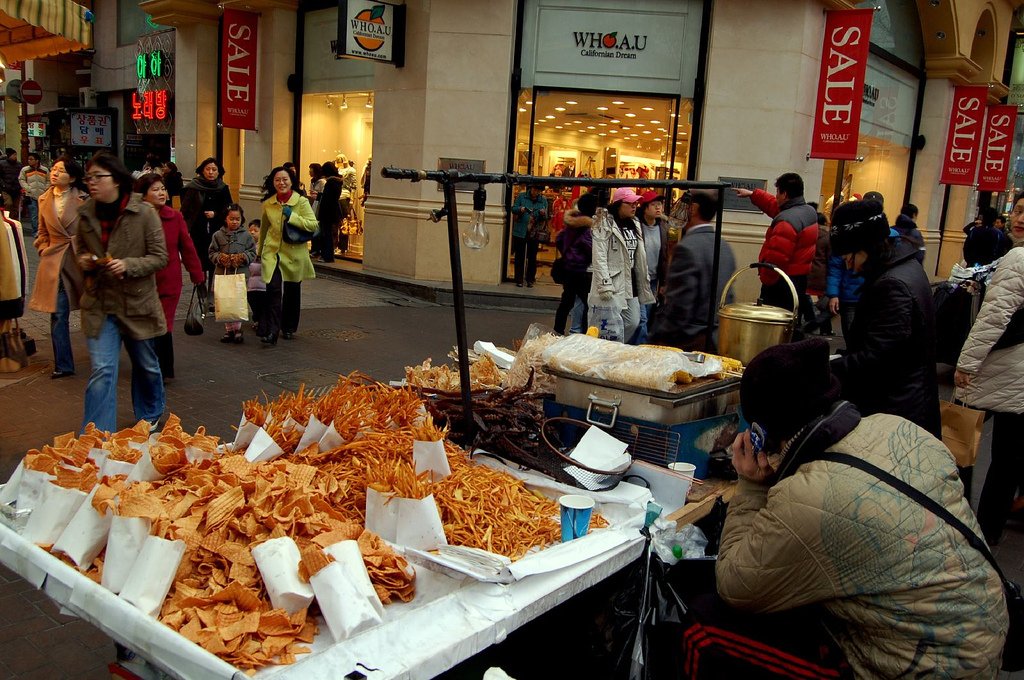
    A street vendor selling fried snacks on a busy Myeongdong shopping street
    Street food stall in Myeongdong. Photo: thelearnr, CC BY 2.0, via Wikimedia Commons

    Things to Do in Myeongdong at a Glance

    Place What it is Cost Time needed Nearest station
    Myeongdong Shopping Street Shops by day, food stalls by night Free to walk 1–2 hours Myeongdong (Line 4), Exits 5–10
    Myeongdong Cathedral Korea’s first Gothic church No ticket 30 minutes Myeongdong (Line 4), Exit 8
    Namsan Cable Car & N Seoul Tower Cable car and city viewpoint Cable car ₩15,000 round trip; observatory ₩29,000 2–3 hours Myeongdong (Line 4), Exit 4
    Namsangol Hanok Village Restored traditional houses Free 1 hour Chungmuro (Lines 3/4), Exit 4
    Namdaemun Market Huge traditional market Free to browse 1–2 hours Hoehyeon (Line 4), Exit 7
    Bank of Korea Money Museum Currency museum in a 1912 bank Free 45 minutes Hoehyeon (Line 4), Exit 7
    Nanta (Myeongdong theater) Non-verbal kitchen percussion show ₩50,000–70,000 One evening show Euljiro 1-ga (Line 2), Exits 5/6
    Department stores & underground mall Christmas displays, souvenirs Free to browse 1 hour Euljiro 1-ga / Hoehyeon

    1. Myeongdong Shopping Street and the Night Food Stalls

    Why go: This is the part of Myeongdong you see in photos: cosmetics shops, fashion brands and K-pop music from shop speakers, packed into a grid of pedestrian streets. In the evening, food carts line the middle of the main street.

    • What to do: Browse the beauty and fashion shops, then eat your way down the stalls. Skewers, tornado potatoes, kimchi-wrapped pork belly and tanghulu (candied fruit) are the usual picks.
    • Getting there: Myeongdong Station (Line 4), Exits 5–10 all come up inside the shopping area.
    • Hours: Open daily; each shop sets its own hours.
    • Cost: Free to walk around.
    • Tip: Stall food here costs more than at a traditional market. Treat it as a snack, and have a proper meal at one of the places in our Myeongdong restaurant guide.

    2. Myeongdong Cathedral (명동대성당)

    Why go: Finished in 1898, it was Korea’s first Roman Catholic parish church and its first Gothic building, and it’s made of brick instead of stone. It sits on a small hill a short walk from the shopping streets.
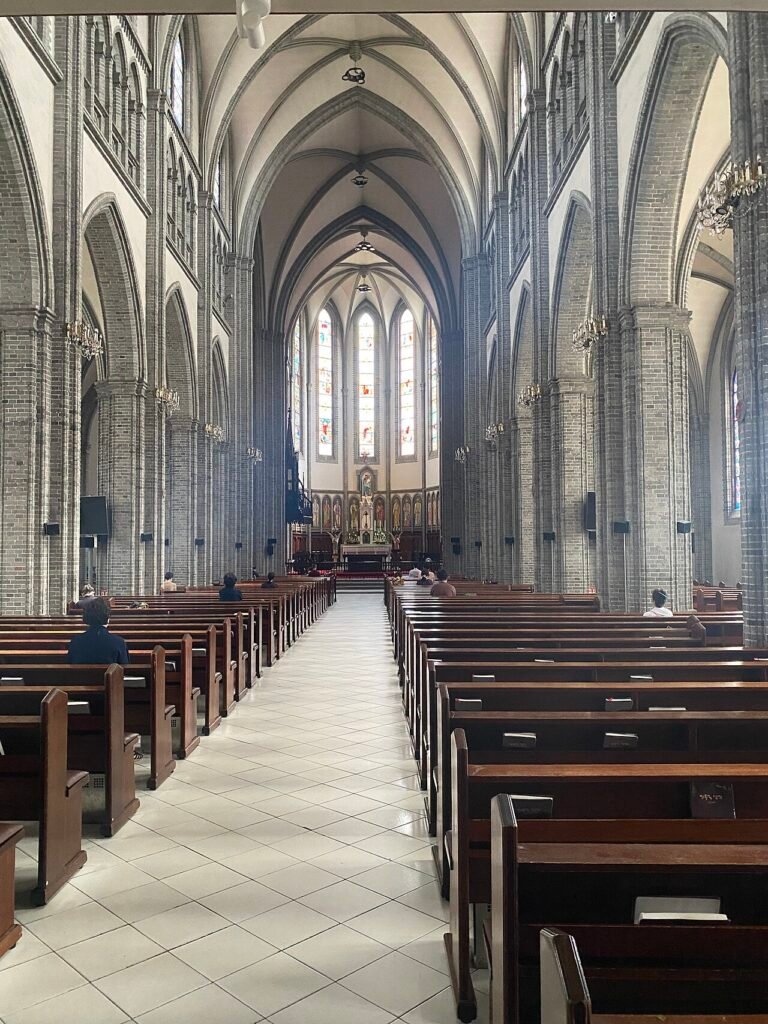
    The Gothic nave of Myeongdong Cathedral with brick columns and stained-glass windows
    Inside Myeongdong Cathedral. Photo: Immanuelle, CC BY 4.0, via Wikimedia Commons
    • What to do: See the nave and stained glass, then go down to the 1898 Myeongdong Cathedral space in the basement, which has a café, gallery and bookstore.
    • Getting there: 74 Myeongdong-gil. Myeongdong Station (Line 4) Exit 8, about 590 m.
    • Hours: You can’t enter the main hall during Mass. Visit Seoul’s two listings give different visiting hours, so check mdsd.or.kr before you go.
    • Cost: No ticket.
    • Tip: It’s a working church. Keep your voice down and don’t take photos during services.

    3. Namsan Cable Car and N Seoul Tower

    Why go: The cable car lower station is a walk uphill from Myeongdong, and the ride to the top of Namsan takes about three minutes. At the top is N Seoul Tower, with a 360-degree view over the city and the famous love-lock fences.
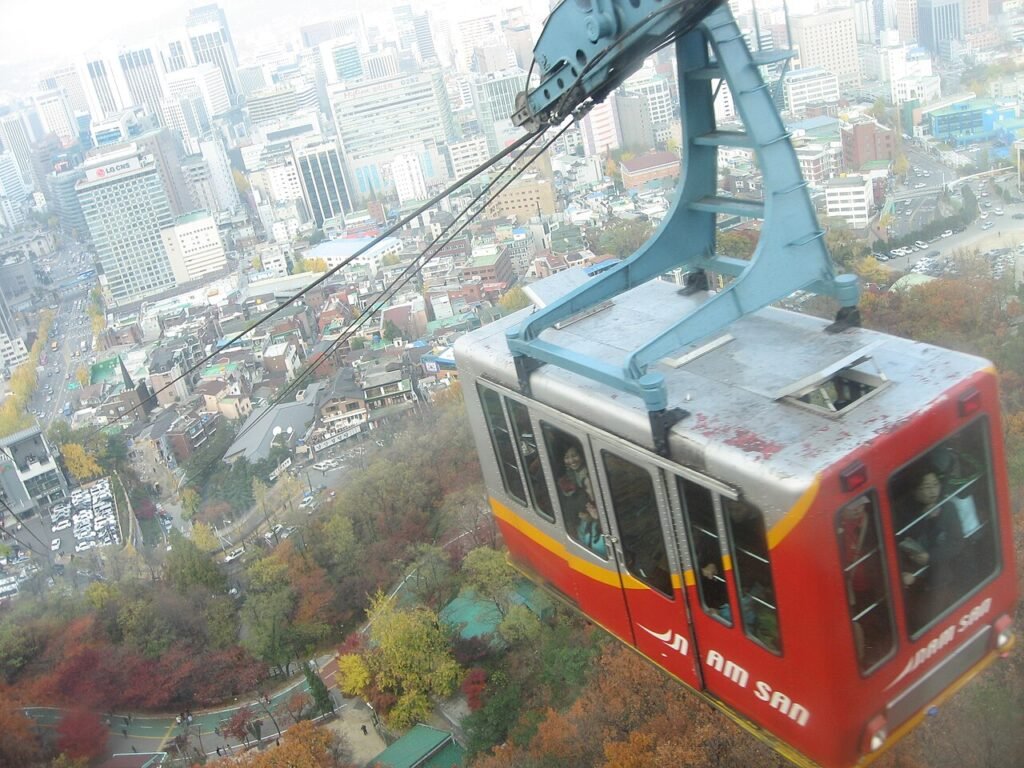
    A red Namsan cable car above autumn trees with central Seoul below
    Namsan Cable Car. Photo: Andrew Bell, CC BY 2.0, via Wikimedia Commons
    • What to do: Ride up, walk the plaza and lock fences for free, and pay for the observatory if you want the view from inside the tower.
    • Getting there: Myeongdong Station (Line 4) Exit 4, about 570 m to the cable car.
    • Hours: Cable car daily 10:00–23:00. Tickets stop 30 minutes before closing, and the cable car can stop running in bad weather. Observatory: weekdays 10:00–22:30, weekends and holidays 10:00–23:00, last entry 30 minutes before closing.
    • Cost: Cable car round trip ₩15,000 for adults (about US$11) and ₩11,500 for children (about US$9). One way is ₩12,000 for adults (about US$9) and ₩9,000 for children (about US$7). Observatory ₩29,000 for adults (about US$22) and ₩23,000 for children aged 3–12 and seniors 65+ (about US$17).
    • Tip: N Seoul Tower’s official site says the observatory will be closed from January to March 2027 for renovation, with the reopening date still to be announced. If your trip falls in those months, you can still ride the cable car, but check nseoultower.co.kr before you buy an observatory ticket.

    4. Namsangol Hanok Village (남산골 한옥마을)

    Why go: It’s the nearest place to Myeongdong to see traditional Korean houses, it’s free, and it sits at the foot of Namsan.

    • What to do: Walk through the restored hanok and the garden, and check for traditional craft programs or events on the day you visit.
    • Getting there: 28 Toegye-ro 34-gil. Chungmuro Station (Lines 3/4) Exit 4, about 300 m.
    • Hours: Tuesday–Sunday. April–October 09:00–21:00; November–March 09:00–20:00. Closed Mondays.
    • Cost: Free.
    • Tip: Chungmuro is the next stop after Myeongdong on Line 4.

    5. Namdaemun Market (남대문시장)

    Why go: Visit Seoul calls it the largest traditional market in Seoul, with more than 10,000 stores around Namdaemun Gate. It sells clothing, food, household goods and souvenirs, many at wholesale prices.

    • What to do: Eat hotteok (sweet filled pancakes), try the kalguksu (knife-cut noodle) alley or braised cutlassfish (galchi-jorim), and shop for souvenirs.
    • Getting there: Hoehyeon Station (Line 4) Exit 7 opens right into the market.
    • Hours: Monday–Saturday; each stall sets its own hours. Closed Sundays.
    • Cost: Free to browse.
    • Tip: There’s a tourist information center inside the market with maps and interpretation help.

    6. Bank of Korea Money Museum (화폐박물관)

    Why go: It’s free and sits in the old Bank of Joseon building, opened on this site in 1912. It has more than 20,000 Korean and foreign banknotes, coins and tokens, and it explains how Korean money is made.

    • What to do: Look at old Korean currency, the world money hall and the old bank building itself.
    • Getting there: 39 Namdaemun-ro. Hoehyeon Station (Line 4) Exit 7, about 310 m.
    • Hours: Tuesday–Sunday 10:00–17:00 (last entry 16:40). Closed Mondays, Lunar New Year and Chuseok.
    • Cost: Free.
    • Tip: It’s a few minutes’ walk from Namdaemun Market, so do the two together.

    7. Nanta at the Myeongdong Theater

    Why go: Nanta is a comedy show set in a kitchen, where cooks drum on pots, pans and cutting boards. There’s almost no dialogue, so you don’t need any Korean.

    • What to do: Book an evening show after a day of sightseeing.
    • Getting there: 3rd floor of the UNESCO Building, 26 Myeongdong-gil. From Euljiro 1-ga Station (Line 2), take the stairs between Exits 5 and 6 and walk straight about 200 m. From Myeongdong Station it’s about 10 minutes on foot.
    • Hours: Shows Mon–Fri 17:00 and 20:00; Saturday 14:00, 17:00 and 20:00; Sundays and holidays 14:00 and 17:00.
    • Cost: VIP ₩70,000 (about US$53), S ₩60,000 (about US$45), A ₩50,000 (about US$38). Children under 36 months go free; everyone from age 3 needs a ticket.
    • Tip: On the official site, you can buy tickets online up to 2 hours before the show and cancel free until 24 hours before. Don’t go to Myeongdong Theater by mistake. It’s a different venue nearby.

    8. Department Stores and the Underground Shopping Center

    Why go: The flagship Lotte and Shinsegae department stores sit on either side of Myeongdong. Both put up big Christmas displays in winter, and in recent years the old Shinsegae building has shown a holiday video on a giant screen across its facade.

    • What to do: See the Christmas displays in season, eat in the basement food halls, and go down to the Myeongdong Underground Shopping Center for K-pop goods and souvenirs at reasonable prices. You’ll also find old stamp and coin dealers down there.
    • Getting there: Lotte is by Euljiro 1-ga Station (Line 2); Shinsegae is by Hoehyeon Station (Line 4).
    • Hours: Each store sets its own hours. Check the store’s website.
    • Cost: Free to browse.
    • Tip: Evenings around Christmas get very crowded, so a weekday visit is easier.

    A Half-Day Myeongdong Route

    This works best Tuesday to Saturday, when everything below is open.

    1. 10:00 Bank of Korea Money Museum (Hoehyeon Station Exit 7).
    2. 11:00 Walk to Namdaemun Market. Have hotteok and noodles for lunch.
    3. 13:00 Walk through the Myeongdong shopping streets to Myeongdong Cathedral.
    4. 15:00 Namsangol Hanok Village, or head straight up to the cable car.
    5. Late afternoon Ride the Namsan Cable Car and stay at the top for sunset.
    6. Evening Come back down for the street food stalls, or catch the 20:00 Nanta show (weekdays and Saturdays).

    On a Sunday, skip Namdaemun Market. On a Monday, swap the museum and the hanok village for a longer walk on Namsan.

    Myeongdong Tips From a Local

    • Check the closing day first. Namdaemun Market closes on Sundays. The Money Museum and Namsangol Hanok Village close on Mondays.
    • Sightsee first, shop later. The food stalls set up toward evening, so the museum, market and cathedral fit better in the morning.
    • Use Naver Map. It gives you walking routes and exit numbers, and it works better in Korea than Google Maps.
    • Carry a little cash. Cards work almost everywhere, but small market stalls are easier with cash.

    Myeongdong Things to Do FAQ

    Is Myeongdong worth visiting if I don’t want to shop?

    Yes. The cathedral, Namsan and N Seoul Tower, Namsangol Hanok Village, Namdaemun Market and the Money Museum are all within walking distance, and most of them are free.

    How do I get from Myeongdong to N Seoul Tower?

    Walk to the Namsan Cable Car (about 570 m from Myeongdong Station Exit 4) and ride up. A round trip costs ₩15,000 for adults.

    Is N Seoul Tower open in early 2027?

    The tower’s official site says the observatory will be closed from January to March 2027 for renovation. Check the site for the reopening date before you buy a ticket.

    What is there to do in Myeongdong on a Monday?

    The shopping streets, the cathedral area, Namsan, the cable car and Namdaemun Market are all open. The Money Museum and Namsangol Hanok Village are closed.

    What can I do in Myeongdong for free?

    Namsangol Hanok Village, the Bank of Korea Money Museum, Myeongdong Cathedral, Namdaemun Market and the Christmas displays in December are all free.
  • Things to Do in Jamsil (2026): Lotte World, Seoul Sky, Seokchon Lake and Olympic Park

    Things to Do in Jamsil (2026): Lotte World, Seoul Sky, Seokchon Lake and Olympic Park

    Short answer: in Jamsil, spend a day at Lotte World Adventure or go up Lotte World Tower to Seoul Sky, then walk around Seokchon Lake as the lights come on. If you’d rather skip the ticket prices, Olympic Park and the Seoul Baekje Museum next to it are huge, green and free.

    Jamsil is in Songpa-gu, in southeast Seoul, and almost everything here sits around one subway station. Lotte owns a big piece of it: the theme park, the tower, the aquarium and the mall all connect underground. A short ride east, Olympic Park covers the grounds of the 1988 Games and a fortress built about 1,600 years earlier. Below are the eight places worth your time, with 2026 prices and hours from the official websites.

    Last checked: 2026-10-28. Prices and hours come from each place’s official website (Lotte World Adventure, Seoul Sky, Lotte World Aquarium, Lotte Museum of Art, Olympic Park, Seoul Baekje Museum). US dollar amounts use Naver’s base exchange rate on 2026-10-28 (₩1,332.80 = US$1), rounded. Theme park hours change by date, so check the link before you go.

    Jamsil in three lines

    • Thrills: Lotte World Adventure, an indoor-and-outdoor theme park
    • Views: Seoul Sky, the observatory at the top of Lotte World Tower
    • Free and relaxed: Seokchon Lake, Olympic Park and the Seoul Baekje Museum

    Things to Do in Jamsil at a Glance

    Place What it is Adult price Time needed Nearest station
    Lotte World Adventure Indoor and outdoor theme park ₩67,000 (~US$50), ₩55,000 after 4 p.m. Half to full day Jamsil, Exit 4
    Seoul Sky Observatory at the top of Lotte World Tower ₩33,000 (~US$25) 1–1.5 hours Jamsil, Exit 1 or 2 (Line 2)
    Lotte World Aquarium Aquarium under Lotte World Mall ₩37,000 (~US$28) 1.5–2 hours Jamsil, Exit 1 or 2 (Line 2)
    Seokchon Lake Lake with a walking loop of about 2.5 km Free 40–60 minutes Jamsil
    Olympic Park 1988 Olympic grounds, sculpture park, ancient earthen fortress Free 2–3 hours Mongchontoseong, Exit 1
    Seoul Baekje Museum Museum of Seoul’s Baekje-era past Free 1 hour Hanseong Baekje, Exit 2
    Lotte World Folk Museum Korean history in miniatures and models Included in the park’s combined ticket, or ₩5,000 45 minutes Jamsil, Exit 4
    Lotte World Mall & Lotte Museum of Art Shopping mall and an art museum in the tower Free to browse; exhibition prices vary 1–2 hours Jamsil, Exit 1 or 2 (Line 2)

    1. Lotte World Adventure

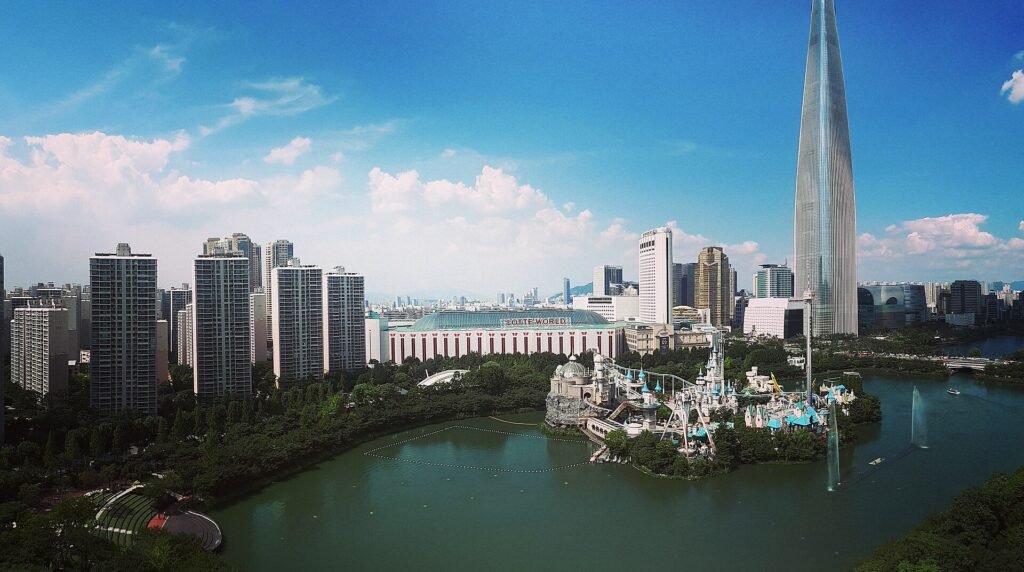
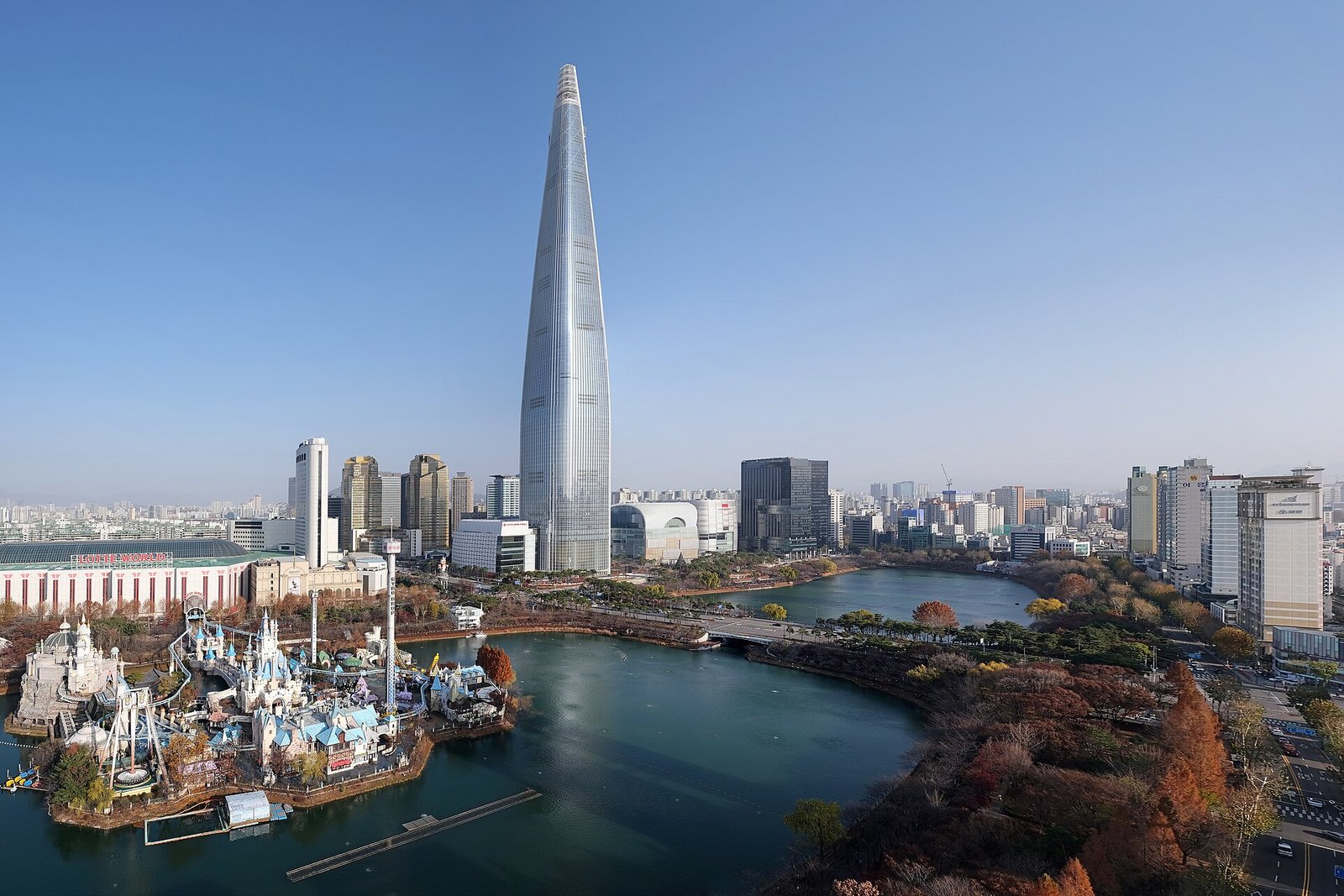
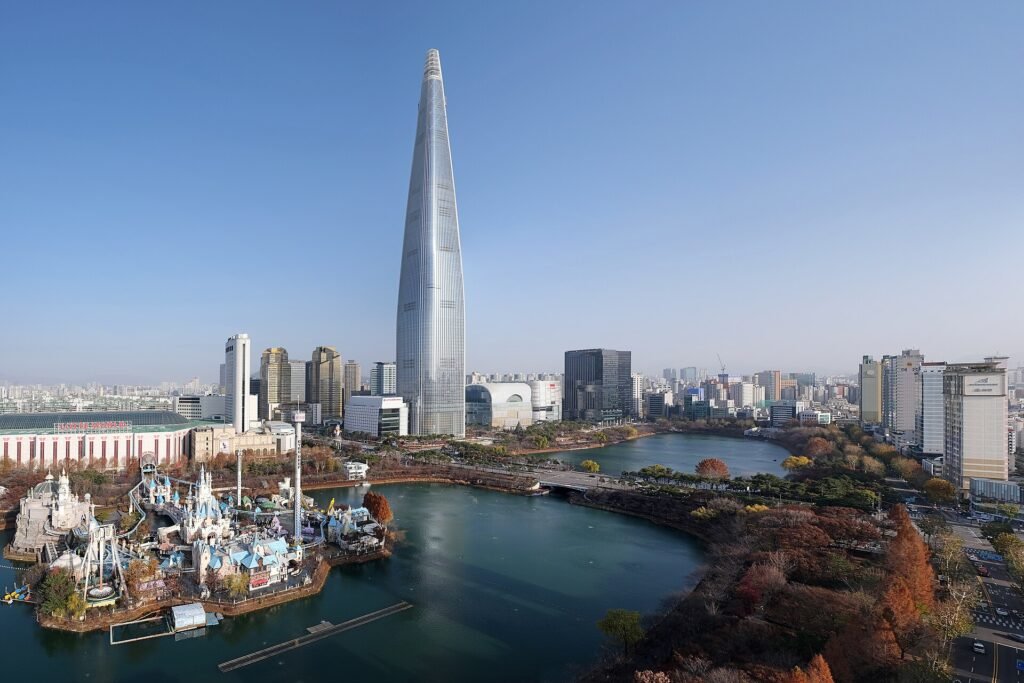
    Lotte World Tower rising above Seokchon Lake and the castle of Lotte World Magic Island in autumn
    Lotte World Tower, Magic Island and Seokchon Lake. Photo: kallerna, CC BY-SA 4.0, via Wikimedia Commons

    Why go: It’s Seoul’s big theme park, and it works in any weather because most of it is indoors. The outdoor half, Magic Island, sits on Seokchon Lake with the castle you see in every Jamsil photo.

    • What to do: Rides and parades indoors, then cross to Magic Island for the outdoor rides and lake views. The combined ticket also gets you into the Folk Museum (see #7).
    • Getting there: Jamsil Station (Lines 2 and 8), Exit 4
    • Hours: Opens at 10:00. Closing time changes by date: in late October it’s 21:00 on weekdays and 22:00 on Fridays and Saturdays. Ticket sales and entry close one hour before closing. Hours for November weren’t posted yet when we checked.
    • Cost: The combined ticket (park plus Folk Museum) is ₩67,000 for adults (about US$50), ₩58,000 for ages 13–18 (about US$44) and ₩50,000 for children aged 36 months to 12 years (about US$38). The After4 ticket, for entry from 4 p.m., is ₩55,000 / ₩47,000 / ₩39,000 (about US$41 / 35 / 29). A park-only ticket is a little cheaper: ₩64,000 for adults, ₩52,000 After4. Visitors aged 65 and over pay the child price.
    • Tip: Games and some extras cost more on top of the ticket. Some Magic Island rides stop in very hot or cold weather, strong wind or heavy rain, so check the park’s “Today’s Park” page on the morning you go.

    2. Seoul Sky (Lotte World Tower)

    Why go: Lotte World Tower is the tallest building in Korea, and Seoul Sky fills its top floors. On a clear day you can see most of the city, the Han River and the mountains around Seoul.

    • What to do: Ride the elevator up, then walk the observation floors and the glass-floor section. Brave visitors can book the Sky Bridge Tour, a guided walk on a bridge outside near the top of the tower.
    • Getting there: Jamsil Station, Line 2 Exits 1 or 2, or Line 8 Exits 10 or 11
    • Hours: Opens daily at 10:30 and closes at 22:00 Sunday to Thursday, 23:00 Friday and Saturday. Entry closes one hour before closing.
    • Cost: ₩33,000 for ages 13 and up (about US$25), ₩29,000 for children aged 36 months to 12 (about US$22). Under 36 months enter free with a guardian. The Seoul Sky + Aquarium package costs ₩62,000 for adults (about US$47) and ₩56,000 for children and seniors 65+ (about US$42).
    • Sky Bridge Tour: ₩130,000 (about US$98) including observatory entry. Tours run at 13:00, 15:00, 17:00 and 19:00 Monday to Thursday, and every hour from 13:00 to 19:00 Friday to Sunday and on holidays. Each tour takes about an hour with up to 12 people. Age and height limits apply. The Sky Bridge closes for winter from November 30, 2026 to February 28, 2027.
    • Tip: Go about an hour before sunset. You’ll see the city in daylight, at dusk and lit up at night on one ticket.

    3. Lotte World Aquarium

    Why go: If you’re traveling with kids or it’s raining, start here. It’s on the lower floors of Lotte World Mall, so you never have to step outside.

    • What to do: Walk the tunnel tank and the themed zones, and catch a feeding session if the timing works.
    • Getting there: Jamsil Station, Line 2 Exits 1 or 2, or Line 8 Exits 10 or 11
    • Hours: Opens daily at 10:00. Closes at 20:00 Monday to Thursday and 22:00 Friday to Sunday. Entry closes one hour before closing.
    • Cost: ₩37,000 for ages 13 and up (about US$28), ₩33,000 for children aged 36 months to 12 (about US$25). Under 36 months enter free.
    • Tip: If you’re going up Seoul Sky too, the combined package (₩62,000 for adults) costs less than buying the two tickets separately.

    4. Seokchon Lake

    Seokchon Lake in Jamsil with Lotte World Magic Island, apartment towers and Lotte World Tower
    Seokchon Lake, Jamsil. Photo: Simon Williams-Im, CC BY 2.0, via Wikimedia Commons

    Why go: Jamsil locals come here for their evening walk. The lake is split in two by a road, and a flat path of about 2.5 km circles both halves, with Lotte World Tower reflected in the water.

    • What to do: Walk or jog the loop, watch Magic Island light up after dark, and look out for art installations. Big inflatable artworks have floated on the lake before.
    • Getting there: A few minutes’ walk from Jamsil Station. The lake is right behind Lotte World Adventure.
    • Cost: Free
    • Tip: In early April the lake is ringed with cherry blossoms. It’s one of Seoul’s most famous blossom walks and gets very crowded on weekends. The east lake (the side away from Lotte World) is usually quieter.

    5. Olympic Park

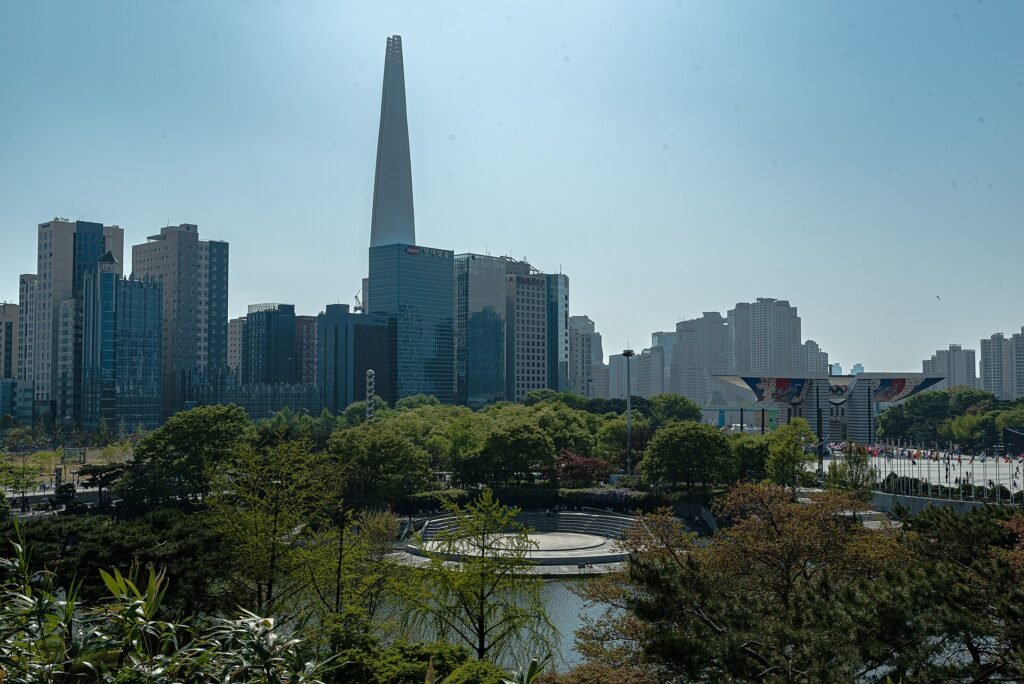
    Seoul Olympic Park with the World Peace Gate on the right and Lotte World Tower in the distance
    Olympic Park with the World Peace Gate. Photo: Woohyun Photos, CC BY-SA 2.0, via Wikimedia Commons

    Why go: Built for the 1986 Asian Games and the 1988 Seoul Olympics, the park is so big that Seoul people come here to picnic, cycle and walk off a whole afternoon. It also holds Mongchontoseong, an earthen fortress from the Baekje kingdom.

    • What to do: Start at the World Peace Gate, walk the grassy walls of Mongchontoseong, and find the “Lone Tree” (나홀로나무), a single tree on a grassy hill that Koreans love to photograph. The park is also full of outdoor sculptures.
    • Getting there: Mongchontoseong Station (Line 8), Exit 1, for the World Peace Gate side. Olympic Park Station (Lines 5 and 9) and Hanseong Baekje Station (Line 9) are also close.
    • Hours: Open all year. On foot or by bike, you can enter 05:00–22:00. The plaza areas stay open until 24:00.
    • Cost: Free
    • Tip: It’s a big park. Pick one side to explore rather than trying to see it all, and wear comfortable shoes. Concerts are often held at the venues inside, so check what’s on if you want a night out.

    6. Seoul Baekje Museum

    Why go: Long before Joseon made Seoul its capital, the Baekje kingdom ruled from this exact spot. This museum on the edge of Olympic Park tells that story clearly, and it costs nothing.

    • What to do: See the cross-section of a Baekje earthen wall, artifacts dug up in Songpa, and the exhibits on Hanseong, Baekje’s first capital.
    • Getting there: Hanseong Baekje Station (Line 9), Exit 2, about 5–6 minutes on foot. From Mongchontoseong Station (Line 8), Exit 1, it’s about 650 m, or a 10–15 minute walk.
    • Hours: 09:00–18:00. Until November 30, 2026, it stays open until 21:00 on Tuesdays, Wednesdays, Fridays, Saturdays and Sundays. Closed Mondays and January 1. When a Monday is a public holiday, it opens as normal.
    • Cost: Free
    • Tip: Visit the museum first, then walk out to Mongchontoseong in the park. The fortress walls make far more sense once you know what they are.

    7. Lotte World Folk Museum

    Why go: It’s inside Lotte World, so most visitors walk right past it. It’s worth stopping for: a quick, visual tour of Korean history through miniature villages, models and reconstructed streets.

    • What to do: Walk the timeline from prehistory to the Joseon dynasty. The miniature village scenes are the highlight.
    • Getting there: Jamsil Station, Exit 4, inside the Lotte World Adventure building
    • Hours: 11:00–19:00 every day
    • Cost: Included in Lotte World Adventure’s combined ticket, but with that ticket you need to enter the museum by 18:00. On its own it costs ₩5,000 for adults (about US$4), ₩3,000 for youth and ₩2,000 for children.
    • Tip: If you’re buying the combined Lotte World ticket anyway, fit this in before 18:00, since entry is already paid for.

    8. Lotte World Mall and Lotte Museum of Art

    Why go: The mall at the foot of Lotte World Tower links the tower, the aquarium and Jamsil Station underground. It’s where you’ll end up eating, shopping or waiting out the rain. The Lotte Museum of Art in the tower brings in large contemporary art shows.

    • What to do: Browse Korean and international brands, eat in the restaurant floors, and check what’s showing at the museum.
    • Getting there: Jamsil Station, Line 2 Exits 1 or 2, or Line 8 Exits 10 or 11
    • Hours: The Lotte Museum of Art is open Monday to Sunday, 10:30–19:00 (last entry 18:30).
    • Cost: Free to browse the mall. Museum tickets depend on the exhibition. The current show, Lee Kang-so, runs until November 1, 2026 and costs ₩20,000 for adults (about US$15).
    • Tip: The museum hadn’t announced its next exhibition when we checked, so look at its website before planning a visit after November 1.

    A One-Day Jamsil Itinerary

    1. 10:00 Seoul Baekje Museum (free), then walk through Olympic Park: Mongchontoseong, the Lone Tree and the World Peace Gate.
    2. 13:00 Lunch, then take the subway back to Jamsil Station (Line 8 from Mongchontoseong).
    3. 14:00 Lotte World Aquarium, or the Folk Museum if you have a Lotte World ticket for later.
    4. 16:30 Go up Seoul Sky about an hour before sunset.
    5. 18:30 Dinner at Lotte World Mall, then walk the Seokchon Lake loop after dark.

    Theme park day instead? Buy the After4 ticket for Lotte World Adventure, spend the morning in Olympic Park, and finish with Seokchon Lake when the park closes.

    Jamsil Tips

    • Check your exit. Jamsil Station is huge. Lotte World Adventure uses Exit 4. Lotte World Tower, Seoul Sky and the aquarium use Exits 1–2 on Line 2, or 10–11 on Line 8.
    • Watch the late nights. Seoul Sky stays open to 23:00 on Fridays and Saturdays, and the aquarium until 22:00 Friday to Sunday.
    • Mondays: The Seoul Baekje Museum is closed. The Lotte attractions stay open.
    • Baseball: Jamsil Baseball Stadium is home to two KBO teams, the LG Twins and the Doosan Bears. If you visit in season, a night game makes a good evening out.
    • Use Naver Map. Search the Korean names (롯데월드, 서울스카이, 석촌호수, 올림픽공원, 한성백제박물관) for accurate walking routes.

    Jamsil FAQ

    How much is Lotte World in 2026?

    A one-day combined ticket (park plus Folk Museum) is ₩67,000 for adults, ₩58,000 for ages 13–18 and ₩50,000 for children. The After4 ticket is ₩55,000 for adults. Prices were checked on the official site on 2026-10-28.

    Is Seoul Sky worth it?

    On a clear day, yes. It’s the highest viewpoint in Seoul. Go around sunset and check the weather first, because haze can hide most of the view.

    Lotte World or Seoul Sky: which should I choose?

    Choose Lotte World if you want a full day of rides. Choose Seoul Sky (₩33,000) if you want the views in an hour or two, then spend the rest of the day at Seokchon Lake and Olympic Park for free.

    What can I do in Jamsil for free?

    Walk Seokchon Lake, explore Olympic Park and Mongchontoseong, and visit the Seoul Baekje Museum. All three are free.

    Is the Seoul Sky Sky Bridge open in winter?

    No. It closes from November 30, 2026 to February 28, 2027. The observatory itself stays open.

  • Things to Do in Dongdaemun (2026): DDP, the City Wall and Late-Night Shopping

    Things to Do in Dongdaemun (2026): DDP, the City Wall and Late-Night Shopping

    Short answer: the best things to do in Dongdaemun are walking around and through Dongdaemun Design Plaza (DDP), climbing the Seoul City Wall from Heunginjimun Gate up to Naksan Park for the view, and coming back after dark for the light show at DDP and the late-night fashion malls. Most of it is free. The one paid extra worth booking this autumn is the DDP Rooftop Tour, which has an English session at 11:00.

    Dongdaemun is two neighborhoods stacked on top of each other. One is a 600-year-old city gate and the wall that runs up the hill behind it. The other is a wholesale fashion district that stays busy until midnight, with a silver building in the middle that looks like it landed from somewhere else. This guide covers both, with hours and prices checked on the official sites.

    Last checked: 2026-10-28. Hours and prices come from each place’s official website (DDP, Seoul Museum of History, Doota Mall) and the Seoul city government. US dollar amounts use Naver’s base exchange rate on 2026-10-28 (₩1,332.80 = US$1), rounded. Event schedules change, so check the links before you go.

    If you only have half a day in Dongdaemun

    • See DDP inside and out, then the free museums in the park next to it
    • Walk the city wall from Heunginjimun Gate up to Naksan Park
    • Come back after dark for the DDP light show and late-night shopping at Doota Mall

    Things to Do in Dongdaemun at a Glance

    Place What it is Cost Time needed Nearest station
    Dongdaemun Design Plaza (DDP) Landmark building, exhibitions, design shops Free to enter; exhibitions vary 1–2 hours Dongdaemun History & Culture Park, Exit 1 or 2
    DDP Rooftop Tour Guided walk on the DDP roof ₩26,000 (~US$20) 1 hour Dongdaemun History & Culture Park
    DDP 365 Light Short outdoor light show every evening Outdoor show in the plaza 15–30 minutes Dongdaemun History & Culture Park
    Dongdaemun History & Culture Park Joseon-era ruins and two small museums Free 30–60 minutes Dongdaemun History & Culture Park, Exit 1 or 2
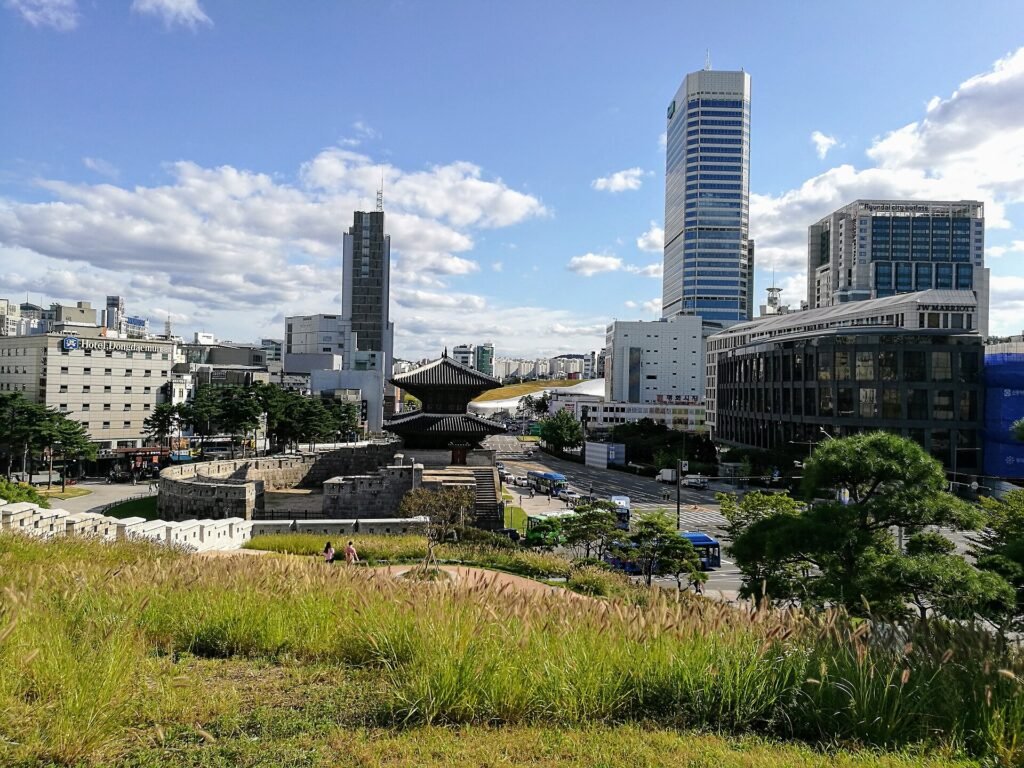
    Heunginjimun Gate & Seoul City Wall Museum The “Great East Gate” and a museum about the wall Free 45–60 minutes Dongdaemun, Exit 1 or 10
    Naksan Park Hilltop park on the city wall with city views Free 1 hour Hyehwa, Exit 2
    Ihwa Mural Village Hillside neighborhood with murals and stairs Free 30–60 minutes Hyehwa, Exit 2
    Doota Mall & the night fashion malls Fashion shopping open until midnight Free to browse 1–2 hours Dongdaemun History & Culture Park
    Central Asian Street Uzbek, Russian and Mongolian shops and restaurants Free to walk 1 hour with a meal Dongdaemun History & Culture Park
    Cheonggyecheon Stream Walking path along a restored stream Free 30 minutes or more Dongdaemun

    1. Dongdaemun Design Plaza (DDP)

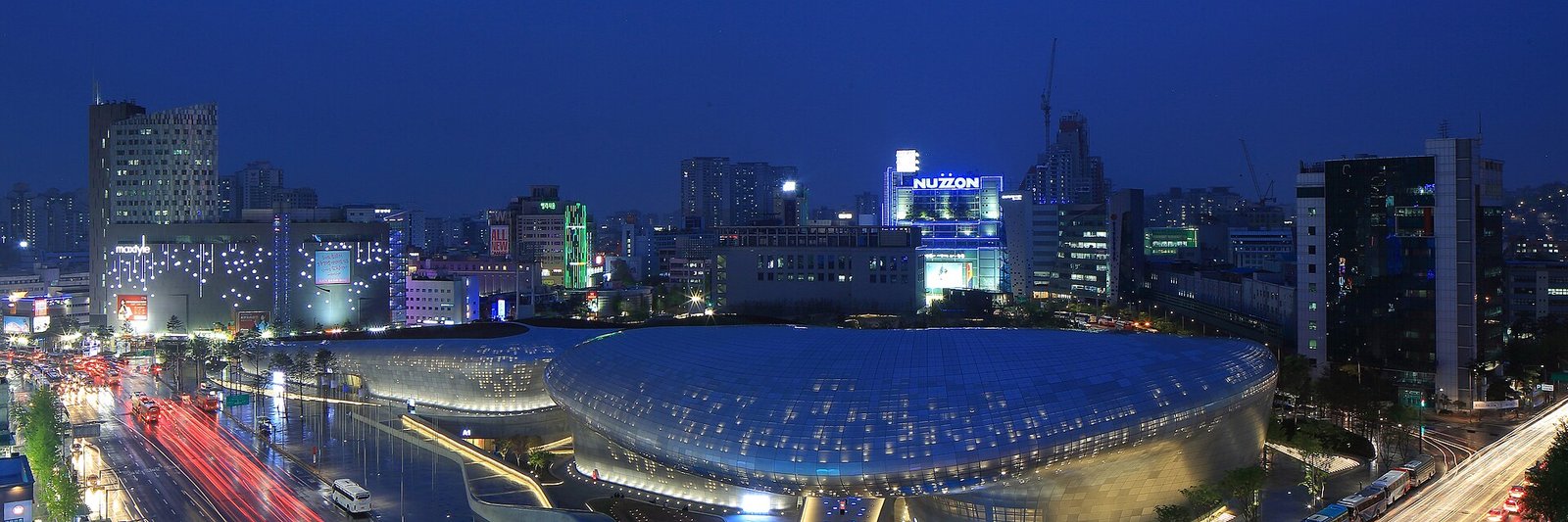
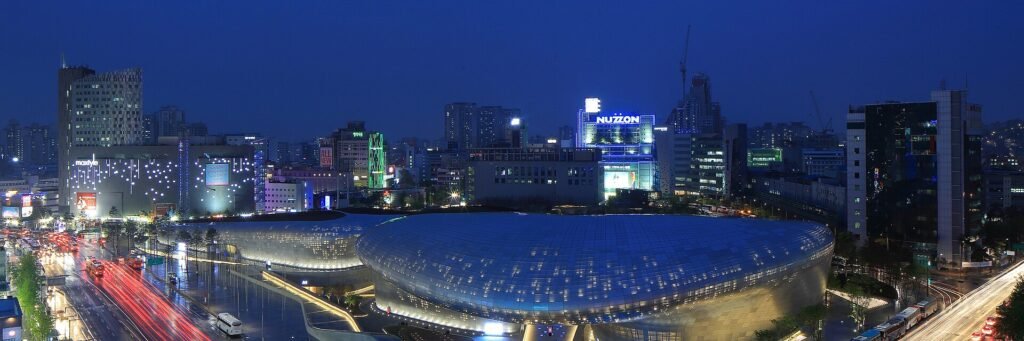
    Dongdaemun Design Plaza lit up at night, with its curved silver panels and the Dongdaemun skyline
    Dongdaemun Design Plaza (DDP) at night. Photo: Eugene Lim, CC BY 2.0, via Wikimedia Commons

    Why go: DDP was designed by Zaha Hadid, and it doesn’t have a single straight wall you’ll notice. You can walk over it, under it and through it without a ticket. It’s also where Seoul holds its fashion week, design fairs and big pop-up events.

    • What to do: Walk the ramps that wrap around the building, check what’s on in the Museum and Art Hall, and browse the DDP Design Store. With no exhibition on, the building alone still fills an hour.
    • Getting there: Dongdaemun History & Culture Park Station (Lines 2, 4 and 5), Exit 1 or 2. Exit 1 opens onto Oullim Plaza on the lower level.
    • Hours: 10:00–20:00. Some spaces keep different hours depending on the program. Closed January 1 and on Seollal and Chuseok days.
    • Cost: Free to enter. Exhibitions and programs set their own prices, and some are free.
    • Tip: The visitor center on B2 (Oullim Plaza, 10:00–20:00) lends wheelchairs and strollers for free if you leave an ID. Paid lockers are near Exit 1 and on the first floor of Design Lab.

    2. DDP Rooftop Tour

    Why go: The rooftop route has been extended to 652 m, and the guided tour walks all of it, with 360-degree views over Dongdaemun. It’s the one part of DDP you can’t see on your own.

    • What to do: You change into a tour outfit, go through a safety briefing, then walk the roof with a guide.
    • Getting there: Meet at the DDP Lounge tour desk, Art Hall 1st floor (entrances A3 and A4).
    • Hours: Runs until November 29, 2026, except Mondays and rainy days. The English tour is at 11:00. Korean tours run at 16:00, plus 13:00 on Fridays to Sundays. Each tour lasts 60 minutes, including changing and the safety briefing.
    • Cost: ₩26,000 (about US$20). If you pay on site, it’s card only.
    • Tip: Only adults aged 18 to 70 can join, and you need ID. Wear sneakers and clothes you can move in. Skirts and dress shoes aren’t allowed. Each tour takes 15 people. Book by phone (02-2153-0310) or email (ddptour@seouldesign.or.kr). Leftover spots open at the desk 10 minutes before the start, and you should be there 20 minutes early.

    3. DDP 365 Light (Evening Light Show)

    Why go: In 2026 Seoul turned DDP’s light shows into a permanent nightly program. Lasers, lighting, video and sound play on the plaza in short bursts all evening.

    • What to do: Find a spot on Oullim Plaza near the excavated ruins and wait for the next show. Each one lasts about 5 minutes.
    • Getting there: Dongdaemun History & Culture Park Station, Exit 1
    • Hours: Every day, on the hour and half-hour in the evening. Start times shift by season. From November to February the first show is at 18:00. The city says times can change.
    • Cost: It’s an outdoor show in the plaza.
    • Tip: DDP also runs bigger festival editions. Seoul Light DDP Autumn ran September 3–13 this year, and a winter season usually follows. Check the DDP site for dates.

    4. Dongdaemun History & Culture Park

    Why go: DDP stands where Dongdaemun Stadium used to be. When the stadium was demolished, archaeologists found Joseon-era military sites and a section of the city wall underneath. The ruins are now laid out right next to DDP.

    • What to do: See the excavated foundations, then pop into the two small museums. The Dongdaemun History Museum covers what was dug up here, and the Dongdaemun Stadium Memorial shows the stadium years. The Igansumun exhibition hall looks at an old floodgate in the city wall.
    • Getting there: Dongdaemun History & Culture Park Station, Exit 1 or 2, or Dongdaemun Station (Line 4), Exit 7
    • Hours: The History Museum and Stadium Memorial are open 10:00–18:00 and close for an hour at 12:00. They’re closed Mondays (holiday Mondays too), January 1, and on Seollal and Chuseok days. Igansumun is open 10:00–20:00.
    • Cost: Free
    • Tip: This makes a good 30-minute stop between DDP and the city wall walk. Don’t plan it for a Monday.

    5. Heunginjimun Gate and the Seoul City Wall Museum

    Heunginjimun Gate and its half-moon outer wall seen from the Seoul City Wall, with DDP and Dongdaemun towers behind
    Heunginjimun Gate seen from the Seoul City Wall. Photo: Teemeah, CC BY-SA 4.0, via Wikimedia Commons

    Why go: Heunginjimun is the “Great East Gate” (Dongdaemun) that gave the whole area its name. It’s the only gate of old Seoul with a half-moon outer wall built in front of it. The museum next door explains how the city wall was built, damaged and restored.

    • What to do: See the gate from the traffic island, then climb the steps behind the museum. The low hill there is the best place to photograph the gate, with DDP behind it.
    • Getting there: Dongdaemun Station (Lines 1 and 4), Exit 1 or 10, about 5 minutes on foot to the museum
    • Hours: The Seoul City Wall Museum is open Tuesday to Sunday, 09:00–18:00 (last entry 17:30). Closed Mondays and January 1.
    • Cost: Free
    • Tip: This is where the Naksan section of the city wall trail starts. If you have the legs for it, follow the wall uphill to Naksan Park.

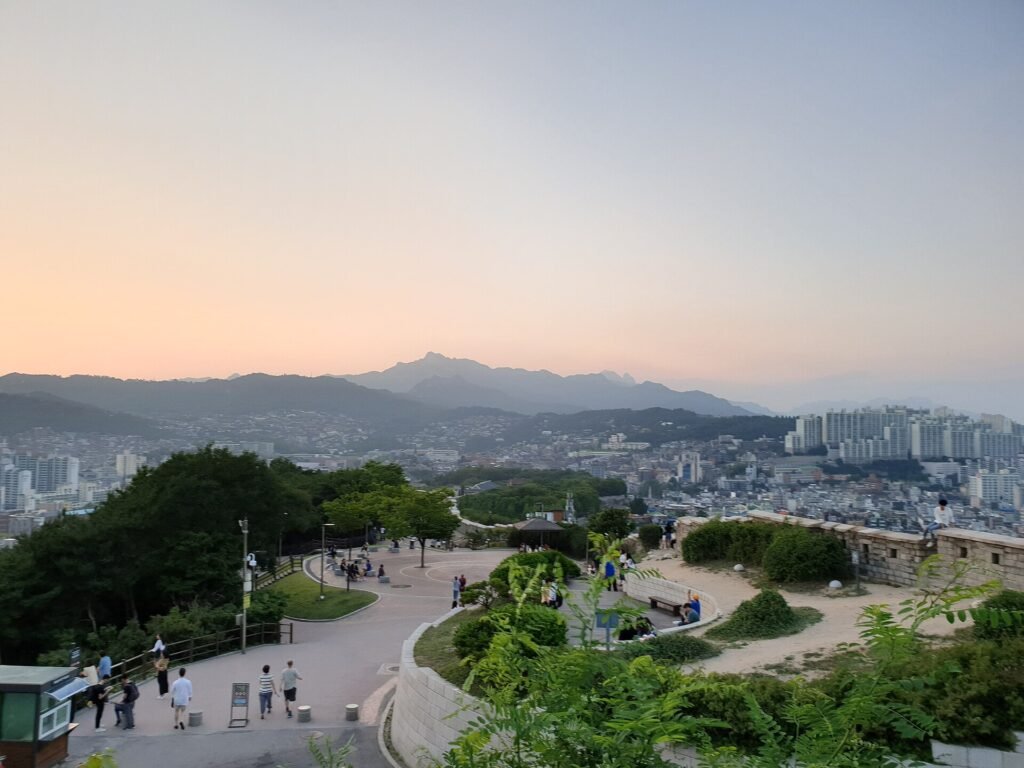
    6. Naksan Park and the City Wall Trail

    Evening view over northern Seoul from Naksan Park along the Seoul City Wall
    Naksan Park and the Seoul City Wall at sunset. Photo: Choism97, CC BY-SA 4.0, via Wikimedia Commons

    Why go: It’s one of the easiest viewpoints in central Seoul. The old stone wall runs along the ridge, and from the top you look out over the rooftops of Jongno toward the mountains to the north. At sunset Seoul students and couples sit along the wall.

    • What to do: Walk the path that follows the wall, either outside it or along the top, then sit at the summit plaza and watch the city lights come on.
    • Getting there: Hyehwa Station (Line 4), Exit 2, about a 10-minute walk uphill. You can also walk up along the wall from Heunginjimun.
    • Cost: Free
    • Tip: The climb from Heunginjimun is steady but short. Coming down, take the Hyehwa side so you end up near the cafés and theaters of Daehak-ro.

    7. Ihwa Mural Village

    Why go: Ihwa-dong is the hillside neighborhood just below Naksan Park, known for murals and painted stairways. It’s a real residential area, which is part of why it feels different from the rest of Dongdaemun.

    • What to do: Wander the lanes and stairs between Naksan Park and Ihwa-dong, look for the murals, and stop at a small café on the way down.
    • Getting there: Hyehwa Station, Exit 2, or downhill from Naksan Park
    • Cost: Free
    • Tip: People live in these houses. Keep your voice down, don’t go into private yards or stairways, and skip the early morning and late evening visits.

    8. Doota Mall and the Night Fashion Malls

    Why go: Dongdaemun is Seoul’s fashion wholesale district, and the shopping goes on long after the rest of the city’s stores have closed. Doota Mall is the easiest of the big malls for visitors: one building of brand stores, with a food court downstairs.

    • What to do: Browse Korean fashion brands floor by floor, and grab a meal or skincare basics on B2, where you’ll find the food court and an Olive Young.
    • Getting there: Dongdaemun History & Culture Park Station. Doota is across the road from DDP.
    • Hours: Doota Mall is open Monday to Sunday, 10:30–00:00.
    • Cost: Free to browse
    • Tip: The wholesale buildings around Doota mostly serve shop owners who buy in bulk. Many stalls may not sell single items or let you try things on, so stick to the retail malls if you just want one jacket.

    9. Central Asian Street

    Why go: A few blocks from DDP, the signs switch to Cyrillic. This small area of Gwanghui-dong is home to Uzbek, Russian, Kazakh and Mongolian shops, bakeries and restaurants. It feels nothing like the malls across the road.

    • What to do: Sit down for Uzbek plov, grab samsa from a clay oven, or buy fresh flatbread from one of the bakeries.
    • Getting there: A short walk from Dongdaemun History & Culture Park Station
    • Cost: Free to walk around
    • Tip: It’s a good dinner stop after DDP, before the light show.

    10. Cheonggyecheon Stream

    Why go: Cheonggyecheon is a stream that was once covered by a road and an elevated highway. It was opened up again in 2005, and its walking path runs below street level right through Dongdaemun.

    • What to do: Walk west along the water toward Gwangjang Market or all the way into central Seoul. The path is flat and much quieter than the streets above.
    • Getting there: Dongdaemun Station. The stream runs just north of the fabric market buildings.
    • Cost: Free
    • Tip: The path makes an easy walking link between Dongdaemun and Euljiro if you’re doing both areas in one day.

    A Half-Day Dongdaemun Itinerary

    1. 14:00 Start at the Seoul City Wall Museum and Heunginjimun Gate (Dongdaemun Station, Exit 1).
    2. 15:00 Walk the wall up to Naksan Park, then drop down through the lanes of Ihwa Mural Village.
    3. 16:30 Head back to DDP by subway or taxi. See the building and the ruins in Dongdaemun History & Culture Park before the museums close at 18:00.
    4. 18:00 Dinner on Central Asian Street.
    5. 19:30 Watch DDP 365 Light on Oullim Plaza, then shop Doota Mall until it closes at midnight.

    Got a free morning? Swap in the 11:00 English DDP Rooftop Tour (until November 29, 2026) and do the wall walk after lunch.

    Dongdaemun Tips

    • Two stations, two names. Dongdaemun Station (Lines 1 and 4) is next to the gate and the city wall. Dongdaemun History & Culture Park Station (Lines 2, 4 and 5) is next to DDP. They’re one stop apart on Line 4, and you can walk between them in about 10 minutes.
    • Mondays are tricky. The city wall museum and the two museums in the park all close on Mondays. DDP itself stays open.
    • Come in the evening. DDP looks best lit up, the light show runs every evening, and the malls stay open late. Dongdaemun is one of the few parts of Seoul where 10 p.m. is still a reasonable time to shop.
    • Use Naver Map. Search the Korean names (동대문디자인플라자, 흥인지문, 낙산공원, 두타몰) for accurate walking routes.

    Dongdaemun FAQ

    Is DDP free?

    Yes. Walking around and through Dongdaemun Design Plaza is free. Some exhibitions and programs charge, and the Rooftop Tour costs ₩26,000.

    What is Dongdaemun famous for?

    Fashion shopping that runs late into the night, the Zaha Hadid-designed DDP, and Heunginjimun, the old east gate of Seoul’s city wall.

    Is Dongdaemun worth visiting at night?

    Yes. DDP is lit up, DDP 365 Light runs on the plaza every evening, and Doota Mall stays open until midnight.

    Is the DDP Rooftop Tour in English?

    Yes, one session a day is. The 11:00 tour is in English and runs Tuesday to Sunday until November 29, 2026 (not on rainy days). It’s for adults aged 18 to 70 only.

    How long do I need in Dongdaemun?

    Half a day covers DDP, the city wall walk and an evening of shopping. Add a morning if you want the Rooftop Tour.

  • Things to Do in Euljiro and Gwangjang Market: 8 Stops in Old Seoul (2026)

    Things to Do in Euljiro and Gwangjang Market: 8 Stops in Old Seoul (2026)

    Short answer: eat your way through the food alley at Gwangjang Market, walk through Jongmyo Shrine (free from October 29 to November 15, 2026), and finish the evening with cheap beer and dried pollack at Euljiro’s Nogari Street. Add the Sewoon rooftop at sunset and you’ve seen the best of the area, an older Seoul that most of the city has built over.

    Euljiro is where Seoul still makes things. By day its alleys are full of print shops, metalworkers, lighting stores and wholesale markets. At night, bars open in the same buildings, and young Seoulites call the area “Hipjiro.” Gwangjang Market sits at its northeastern edge, and Jongmyo, a UNESCO World Heritage site, is a short walk away. This guide puts them together into one walkable day.

    Last checked: 2026-10-28. Hours and fees come from official sources (Gwangjang Market’s website, the Royal Palaces and Tombs Center for Jongmyo, and Visit Seoul). Where no official number exists, I’ve left it out. Check before you go.

    Euljiro and Gwangjang Market at a Glance

    Place What it is Cost Time needed Nearest station
    Gwangjang Market food alley Korea’s best-known market food stalls Free to enter; pay per dish 1–1.5 hours Jongno 5-ga (Line 1), Exit 8
    Gwangjang Market vintage shops Second-hand clothing on the upper floor Free to browse 30–60 min Jongno 5-ga (Line 1), Exit 8
    Jongmyo Shrine Royal ancestral shrine, UNESCO World Heritage Free Oct 29–Nov 15, 2026 1–1.5 hours Jongno 3-ga (Lines 1, 3, 5)
    Sewoon Plaza and rooftop 1968 electronics arcade with a city view Free to walk 45–60 min Jongno 3-ga, Exit 12
    Cheonggyecheon Stream Walking path along a restored urban stream Free 30–60 min Jongno 3-ga or Euljiro 4-ga
    Euljiro Nogari Street Outdoor beer tables and dried pollack Pay as you drink 1–2 hours (evening) Euljiro 3-ga (Lines 2, 3), Exit 4
    Lighting district and Hipjiro alleys Lighting shops, workshops, hidden bars and cafés Free to walk 1 hour Euljiro 3-ga, Exit 2
    Bangsan Market Baking, candle-making and packaging supplies Free to browse 30–60 min Euljiro 4-ga (Lines 2, 5)

    1. Gwangjang Market Food Alley (광장시장 먹자골목)

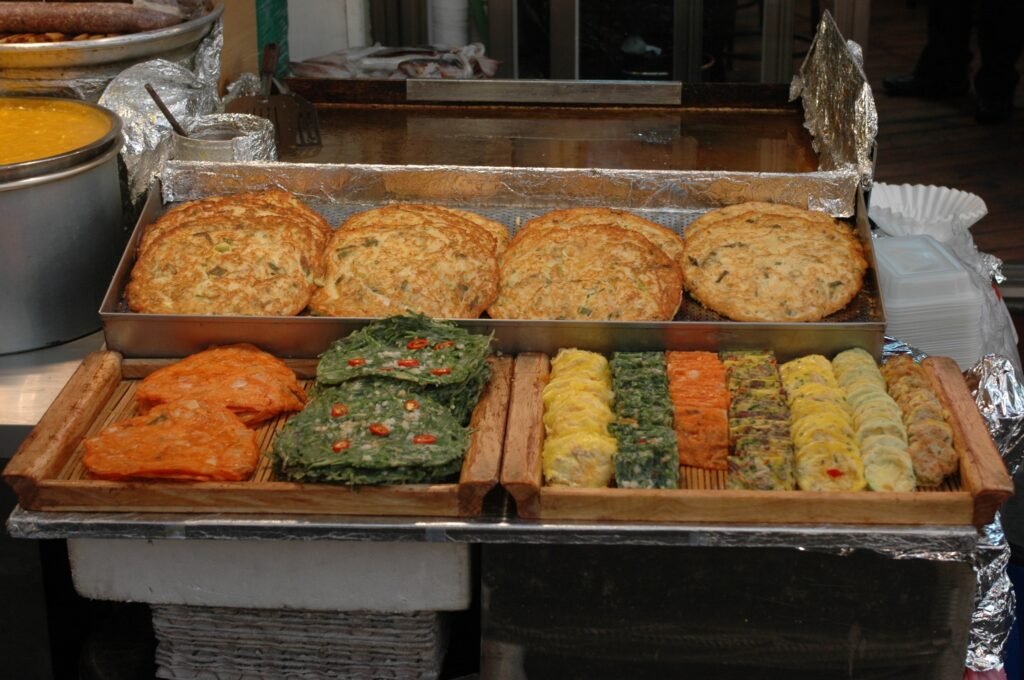
    Trays of bindaetteok mung bean pancakes and other jeon at a Gwangjang Market stall
    Bindaetteok and other jeon at Gwangjang Market. Photo: Pfc. Bo Park, 2ID PAO, US Army, public domain, via Wikimedia Commons

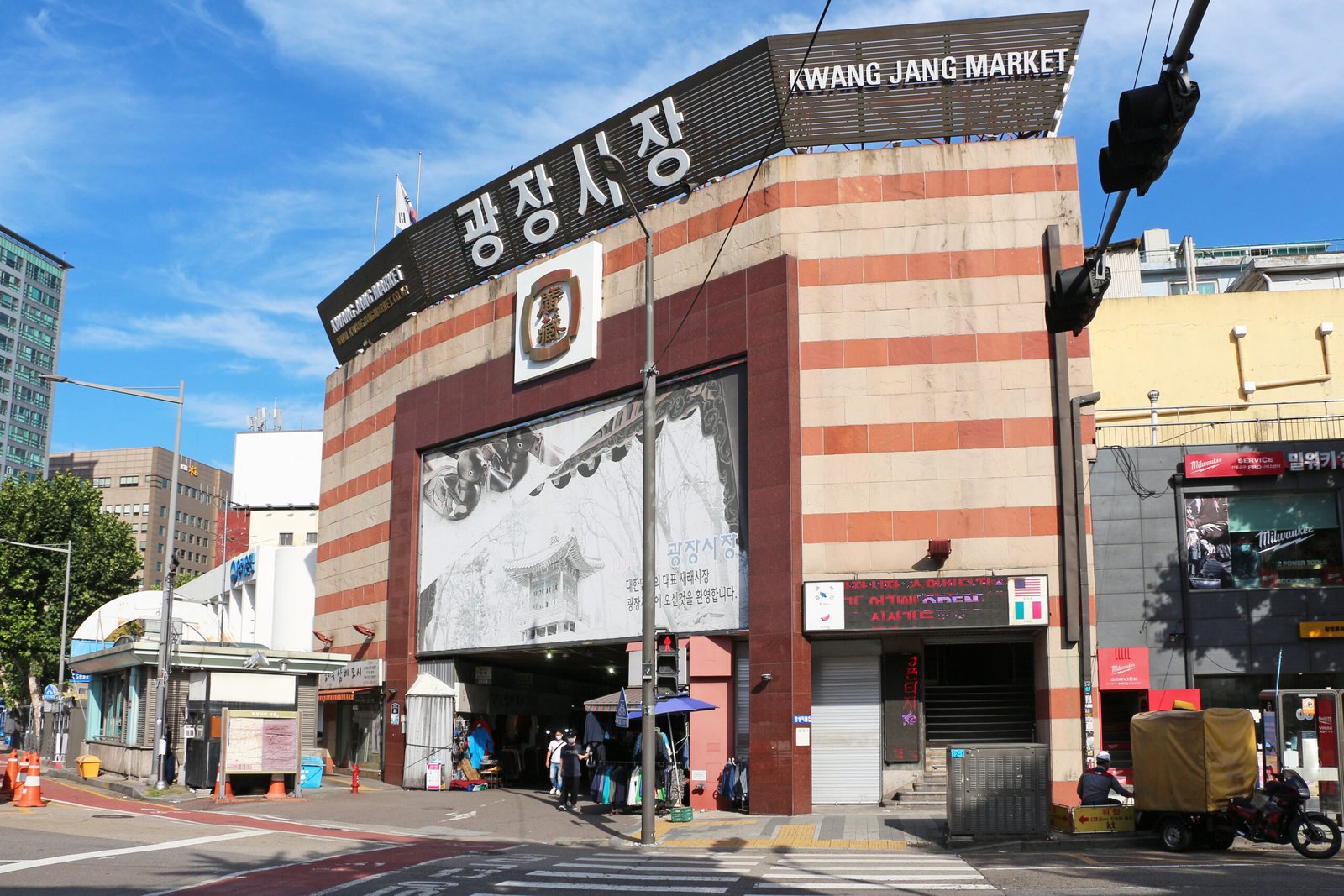
    Why go: The market calls itself Korea’s first permanent market, with more than 100 years of history. The food alley in the middle is where most visitors end up. Rows of stalls fry mung bean pancakes, roll small gimbap and slice raw beef while you sit on a bench at the counter.

    • What to eat: Bindaetteok (mung bean pancake), mayak gimbap (small “addictive” rice rolls with mustard dipping sauce), yukhoe (Korean beef tartare), tteokbokki and eomuk (fish cakes). Visit Seoul lists all of these as the market’s signature foods.
    • Getting there: Jongno 5-ga Station (Line 1), Exit 8. The market is about 60 m away.
    • Hours: The food alley is open until 23:00, every day of the year. The rest of the market runs 09:00–18:00 and closes on Sundays.
    • Cost: Free to enter. You pay per dish.
    • Tip: Ask the price before you order, and check the portion size too. Keep your bag zipped, too. Visit Seoul’s own page notes that some visitors have complained about pickpocketing in the crowds.

    2. Gwangjang Market Vintage Shops (광장시장 구제상가)

    Why go: Upstairs from the food stalls is one of Seoul’s biggest clusters of second-hand clothing shops. Korean students and stylists come here to dig for jackets, knitwear and denim, and there are hanbok shops on the same floor.

    • What to do: Take the stairs to the second floor and work through the stalls. Prices are per piece, so take your time.
    • Getting there: Inside Gwangjang Market, second floor. Jongno 5-ga Station (Line 1), Exit 8.
    • Hours: 10:00–19:00. Closed Sundays, but open on public holidays.
    • Cost: Free to browse
    • Tip: Carry some cash. Small stalls are quicker to pay with it.

    3. Jongmyo Shrine (종묘)

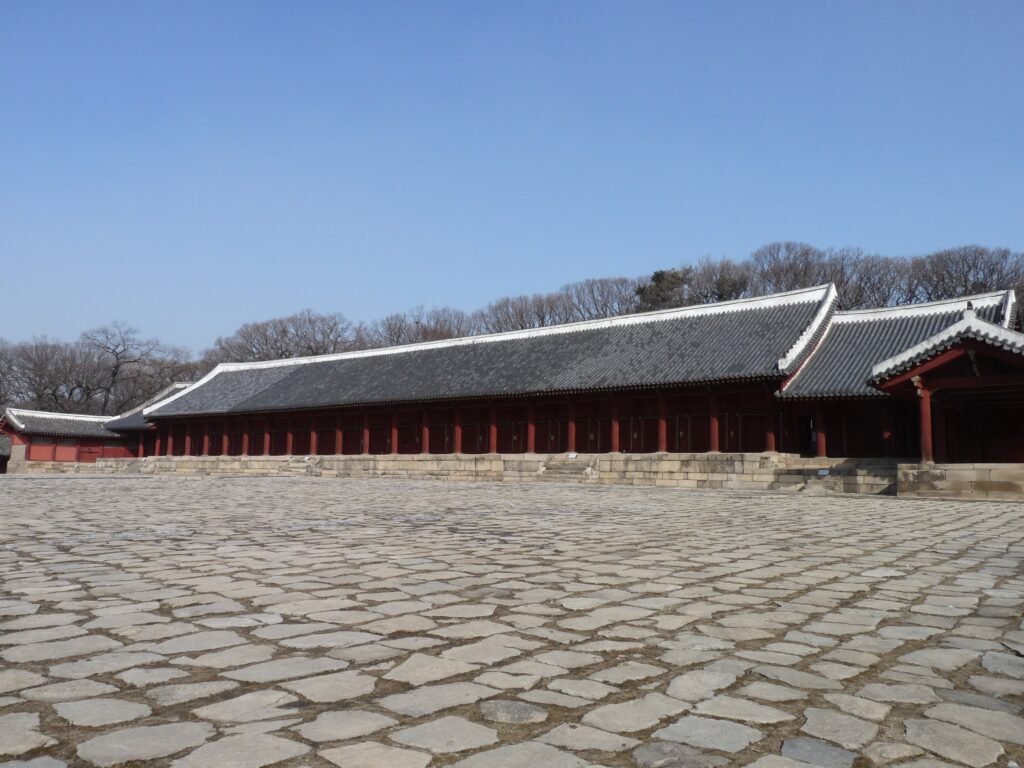
    Jeongjeon, the long main hall of Jongmyo Shrine, behind its stone courtyard
    Jeongjeon, the main hall of Jongmyo Shrine. Photo: João Trindade, CC BY 2.0, via Wikimedia Commons

    Why go: Jongmyo is where the Joseon kings and queens were enshrined, and it’s on the UNESCO World Heritage list. The main hall, Jeongjeon, is one of the longest wooden buildings in Korea. The wide stone courtyard in front of it is very quiet for the middle of the city.

    • What to do: Walk the stone paths to Jeongjeon and the smaller hall, Yeongnyeongjeon. Join an English-language tour if the timing works. The guides explain the rituals that are still performed here.
    • Getting there: Jongno 3-ga Station, Exit 11 (Line 1) or Exit 8 (Lines 3 and 5)
    • Hours: Closed Tuesdays. On most days you enter by timed guided tour. Saturdays, the last Wednesday of the month and public holidays are free-viewing days, when you can walk around on your own. Groups of fewer than 10 don’t need to book ahead.
    • Cost: Free from October 29 to November 15, 2026, during the Korea Grand Festival. No booking is needed then, and you can walk around freely. Outside that period, check the official site for the current fee.
    • Tip: During the free period, English tours run at 10:00 and 14:00 on Mondays, Wednesdays, Thursdays, Fridays and Sundays (Korean only on Saturdays). On Saturday, November 7, 2026, Jongmyo holds its autumn ancestral rite, Chuhyang Daeje: 10:00–12:00 at Yeongnyeongjeon and 14:00–16:30 at Jeongjeon. It’s free to watch and doesn’t need a booking. Details are on the Royal Palaces and Tombs Center site.

    4. Sewoon Plaza and the Sewoon Rooftop (세운상가)

    Why go: Completed in 1968, Sewoon was Korea’s first electronics market. It’s still full of small shops selling audio gear, parts, lighting and repair services, and the rooftop has a view down onto Jongmyo with the towers of central Seoul behind it.

    • What to do: Ride up to the Sewoon Rooftop on the 9th floor for the view, then walk the elevated pedestrian bridge that links Sewoon to the neighboring Cheonggye and Daelim arcades. Poke into the old electronics shops on the way down.
    • Getting there: Jongno 3-ga Station (Lines 1, 3 and 5), Exit 12, about 280 m
    • Hours: Shops are generally open Monday–Saturday 09:00–19:00, and hours vary by store. Closed Sundays and public holidays. Visit Seoul lists the rooftop as open on weekdays 10:00–20:00.
    • Cost: Free
    • Tip: Parts of the Sewoon district are slated for redevelopment, so access to walkways and buildings may change. Go on a weekday if you want to see the shops working.

    5. Cheonggyecheon Stream (청계천)

    Why go: This restored stream runs below street level right through the area, passing between Sewoon and Gwangjang Market. It’s the easiest way to walk between the two, and quieter than the roads above.

    • What to do: Take the stairs down from any bridge and follow the water. Heading west takes you toward Gwanghwamun, and heading east takes you toward Dongdaemun.
    • Getting there: Stairs lead down from the bridges along Cheonggyecheon-ro, near Jongno 3-ga and Euljiro 4-ga stations.
    • Hours: An open-air public path with no gate
    • Cost: Free
    • Tip: Come back after dark. The lights under the bridges make it a pleasant walk to Nogari Street.

    6. Euljiro Nogari Street (을지로 노가리골목)

    Why go: On warm evenings, the alleys behind Euljiro 3-ga fill with plastic tables. Office workers sit outside with cheap draft beer and nogari (small dried pollack, grilled and dipped in spicy mayo-soy sauce). It’s a very Seoul way to spend an evening.

    • What to do: Grab a table outside, order a beer and a plate of nogari, and stay as long as you like. Visit Seoul calls Manseon Hof the center of the scene. It’s open daily 12:00–03:00 and has red and blue outdoor tables.
    • Getting there: Euljiro 3-ga Station (Lines 2 and 3), Exit 4
    • Hours: Each bar sets its own. Things get busy after office hours.
    • Cost: Pay as you drink
    • Tip: In cold or rainy weather the outdoor tables thin out, and it’s more fun on a dry evening.

    7. The Lighting District and Hipjiro Alleys (을지로 조명거리·힙지로)

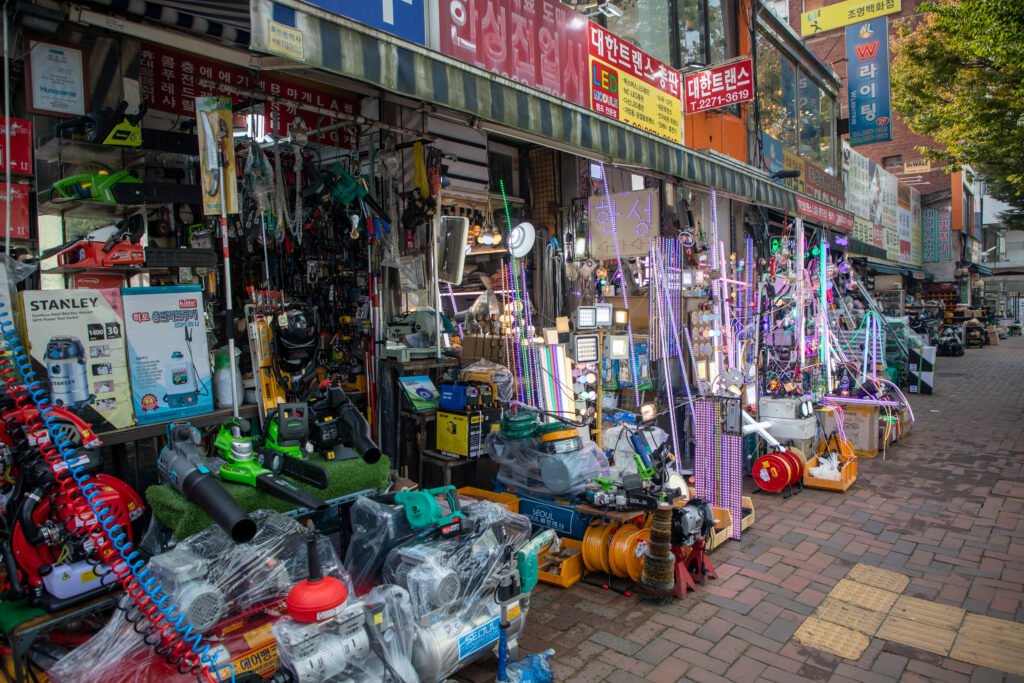
    Lighting and tool shops lining a street in Euljiro, Seoul, with LED strips on display
    Lighting and tool shops in Euljiro. Photo: Aaaatu, CC BY-SA 4.0, via Wikimedia Commons

    Why go: Between Euljiro 3-ga and Euljiro 4-ga stations, the street is lined with shops selling chandeliers, LED strips and every kind of lamp. Behind them are narrow alleys of steel workshops and print shops, and that’s where the hidden bars and cafés of “Hipjiro” are.

    • What to do: Walk the lighting shops along the main road, then turn into the side alleys. Many of the bars and cafés have no sign at street level, and some are up a staircase above a workshop. Look for the graffiti and the benches that Visit Seoul mentions.
    • Getting there: Euljiro 3-ga Station, Exit 2, then walk east toward Euljiro 4-ga
    • Hours: Shops keep weekday business hours. Bars open in the evening.
    • Cost: Free to walk
    • Tip: The workshops are real businesses. Step aside for delivery carts and forklifts, and ask before you photograph people at work.

    8. Bangsan Market (방산시장)

    Why go: Visit Seoul calls it the best place in Seoul for baking supplies, candle- and fragrance-making supplies, and packaging and wrapping. If you bake or make crafts, you’ll find Korean-style boxes, ribbons, molds and tools at wholesale prices.

    • What to do: Browse the baking tools and packaging shops. The Korean gift boxes and bags make cheap, light souvenirs.
    • Getting there: Near the Euljiro lighting district, a short walk from Euljiro 4-ga Station (Lines 2 and 5)
    • Hours: Each shop sets its own, so check Naver Map before you go
    • Cost: Free to browse
    • Tip: Some shops sell mainly in bulk, so ask if you only want a few pieces.

    Half-Day Euljiro and Gwangjang Route

    1. 10:00 Jongmyo Shrine (Jongno 3-ga Station). Join the 10:00 English tour during the free period, or walk around on your own.
    2. 11:30 Walk south to Sewoon Plaza and go up to the rooftop.
    3. 12:30 Head down to Cheonggyecheon and walk east to Gwangjang Market.
    4. 13:00 Lunch in the food alley, then the vintage shops upstairs.
    5. 15:00 Bangsan Market and the lighting district on the way west.
    6. 18:00 Beer and nogari at Euljiro Nogari Street (Euljiro 3-ga Station, Exit 4).

    Avoid Tuesdays (Jongmyo is closed) and Sundays (most of Gwangjang Market, Sewoon’s shops and the vintage floor are closed).

    Tips for Visiting Euljiro

    • Weekdays are best. Euljiro is a working neighborhood. Many shops close on Sundays.
    • Carry some cash. Cards work almost everywhere, but market stalls and small shops are faster with cash.
    • Everything is walkable. Jongmyo, Sewoon, Gwangjang Market and Nogari Street are all within about 20 minutes on foot of each other.
    • Use Naver Map. Many Euljiro bars are hidden upstairs with no English sign. Naver Map shows which floor to go to and today’s hours.

    Euljiro and Gwangjang Market FAQ

    What time does Gwangjang Market open?

    The market runs 09:00–18:00 and is closed on Sundays. The food alley stays open until 23:00 every day of the year, and the vintage shops are open 10:00–19:00 (closed Sundays).

    Is Gwangjang Market open on Sunday?

    The food alley is. Most of the clothing and fabric shops and the vintage floor are closed.

    What should I eat at Gwangjang Market?

    Bindaetteok (mung bean pancake), mayak gimbap and yukhoe (beef tartare) are the three most visitors try. Tteokbokki and fish cakes are easy add-ons.

    Do I need to book Jongmyo Shrine?

    Not from October 29 to November 15, 2026, when entry is free and open. Outside that period, most days are timed guided tours, but groups of fewer than 10 can buy on-site. Saturdays are free-viewing days.

    Why is Euljiro called Hipjiro?

    It’s a play on “hip” and “Euljiro.” Young Seoulites started opening bars and cafés inside the old print shops and workshops, and the nickname stuck.

  • Korea Fall Foliage 2026: Where to See Autumn Leaves Now (Forecast + Seoul Spots)

    Korea Fall Foliage 2026: Where to See Autumn Leaves Now (Forecast + Seoul Spots)

    Short answer: as of October 29, 2026, Korea fall foliage is peaking in and around Seoul. The Korea Forest Service forecasts the national peak for ginkgo on October 30 and for maples and oaks on October 31, so this weekend is a good time for Seoul’s palaces, Namsan, and day trips to Nami Island or Hwadam Forest. Over the next two weeks the color moves south. Naejangsan peaks in early November, with Jirisan and the rest of the south after it. Seoraksan, in the northeast, is already past its forecast peak.

    Most English guides to Korea’s autumn leaves were written before the season started, and few say where their dates come from. Below, every date is tagged with its source, and each place comes with how to get there from Seoul, what it costs, and whether you need to book.

    Last checked: 2026-10-29. Forecast dates are from the Korea Forest Service’s 2026 Fall Foliage Peak Prediction Map (released September 22, 2026), Weatheri’s 2026 foliage forecast (September 4, 2026) and the 2026 Autumn Leaves Map from the Korea Tourism Organization and Korea National Arboretum (October 8, 2026). Fees and hours are from each place’s official website. Rain or a cold snap can shift any of these by a few days.

    Korea Fall Foliage 2026 Forecast: Where It Peaks and When

    Korean sources don’t agree on what “peak” means. The Korea Forest Service calls it when about 50% of the forest has turned, while the Korea Meteorological Administration (KMA) waits for about 80%, so the two can put the same mountain’s peak several days apart.

    Place Region Expected peak (source) Getting there from Seoul
    Seoul palaces, Namsan, city streets Seoul Ginkgo Oct 30, maples and oaks Oct 31 (Korea Forest Service, nationwide by tree type) Subway
    Korea National Arboretum Pocheon, Gyeonggi (capital area) Maples Oct 29, ginkgo Oct 31, oaks Nov 2 (KTO / National Arboretum map) Car or tour (north of Seoul)
    Hwadam Forest Gwangju, Gyeonggi No site-specific forecast. Capital-area reference: Oct 29–Nov 2 (National Arboretum figures above) Gyeonggang Line to Gonjiam Station, then taxi or bus
    Nami Island Chuncheon, Gangwon No site-specific forecast. Nearby Gangwon Provincial Arboretum in Chuncheon: ginkgo Oct 27, maples Oct 28, oaks Oct 31 (KTO / National Arboretum map) ITX-Cheongchun train to Gapyeong Station, then bus, taxi or a 20-minute walk to the ferry
    Seoraksan Gangwon (northeast) Oct 20 (Korea Forest Service); Oct 25 (Weatheri) Express bus to Sokcho, then local bus or taxi
    Songnisan Chungbuk Oct 28 (Korea Forest Service) Intercity bus; check routes on Naver Map
    Naejangsan Jeongeup, Jeonbuk Nov 1 (Weatheri); Nov 4 (Korea Forest Service); around Nov 7–8 (Jeongeup City) Train to Jeongeup, then city bus 171 or 171-1
    Jirisan and the south Southern region Nov 5–13 (Weatheri, regional range) Long day; better as an overnight trip
    Hallasan Jeju Nov 6 (Korea Forest Service) Flight to Jeju

    As for what has actually been observed this season, the Korea Forest Service logged the first color of 2026 on September 14 at the Jeombongsan reserve in Inje, Gangwon. According to the KMA, as reported by Korea JoongAng Daily, Odaesan reached peak on October 14, and the first color showed up on Bukhansan, Seoul’s big mountain, the same day.

    Where to See Autumn Leaves in Seoul Right Now

    The timing also works in your favor this year: the four main palaces, Jongmyo Shrine and the Joseon royal tombs are free to enter from October 29 to November 15, 2026 for the Korea Grand Festival, according to the Royal Palaces and Tombs Center. Regular closing days still apply, and the free entry doesn’t cover the Changdeokgung Secret Garden special tour.

    Deoksugung Palace and the stone-wall road

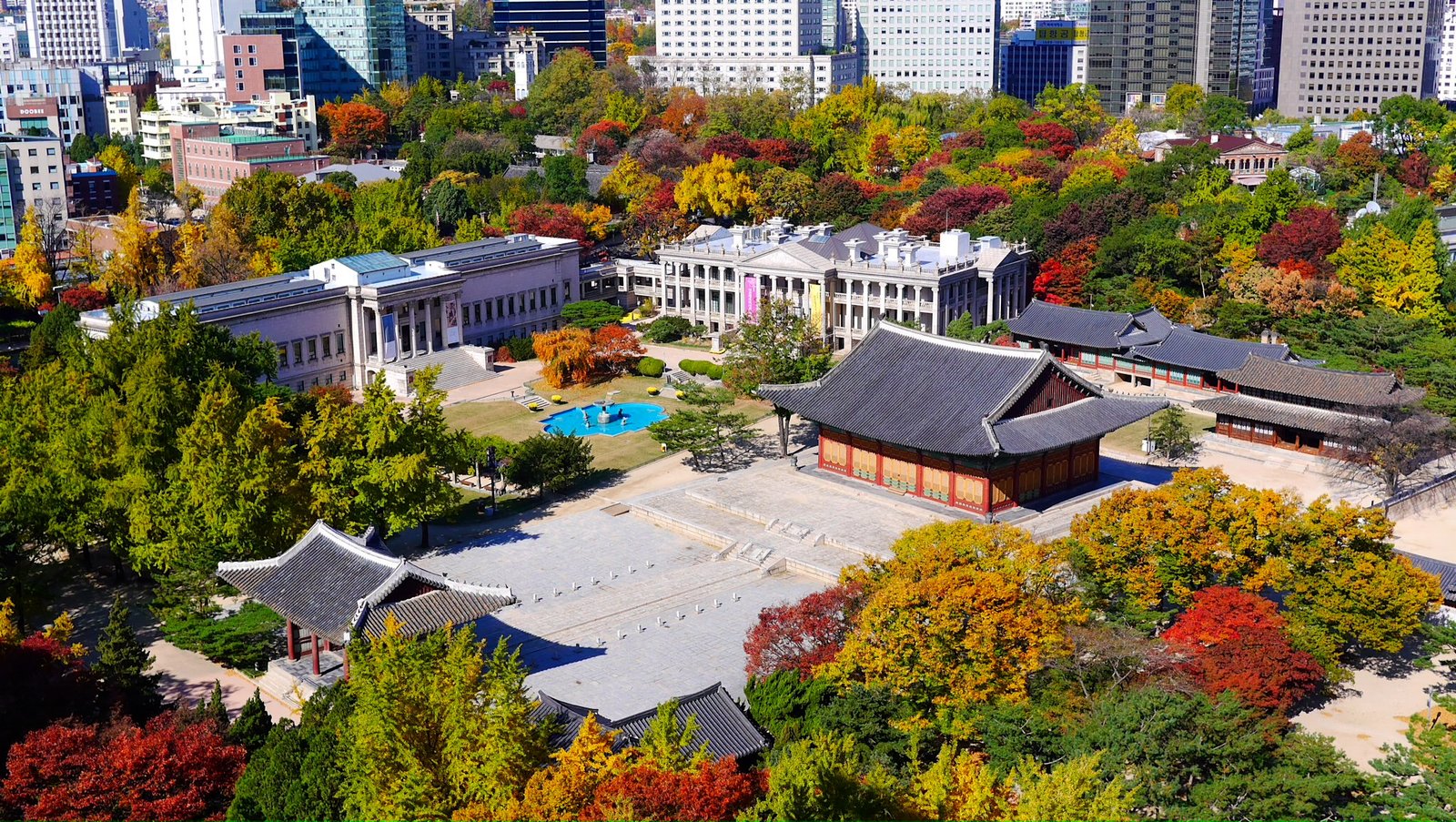
    Deoksugung is a small palace across from Seoul City Hall, and its ginkgo and maple trees turn the whole compound red and yellow. The stone-wall road (Deoksugung-gil) along its outer wall is a popular autumn walk.

    Deoksugung Palace in Seoul surrounded by red and yellow autumn trees, with office towers behind
    Deoksugung Palace in autumn. Photo: travel oriented, CC BY-SA 2.0, via Wikimedia Commons
    • Getting there: City Hall Station (Lines 1 and 2)
    • Hours: 09:00–21:00 (last entry 20:00). Closed Mondays.
    • Cost: Free until November 15. Normally ₩1,000 for foreign adults aged 19–64.
    • Good to know: The palace has posted a notice about construction on its outer wall from September 21 to November 19, 2026. Parts of the stone-wall road may not look like the usual photos this year.

    Gyeongbokgung and Changdeokgung

    Gyeongbokgung is the biggest palace and draws the biggest crowds. Look for ginkgo trees leaning over the walls around the edges of the grounds. Changdeokgung is quieter. Its rear garden, Huwon (the Secret Garden), is a wooded valley of ponds and pavilions that you enter with a timed ticket, and autumn tickets go fast.

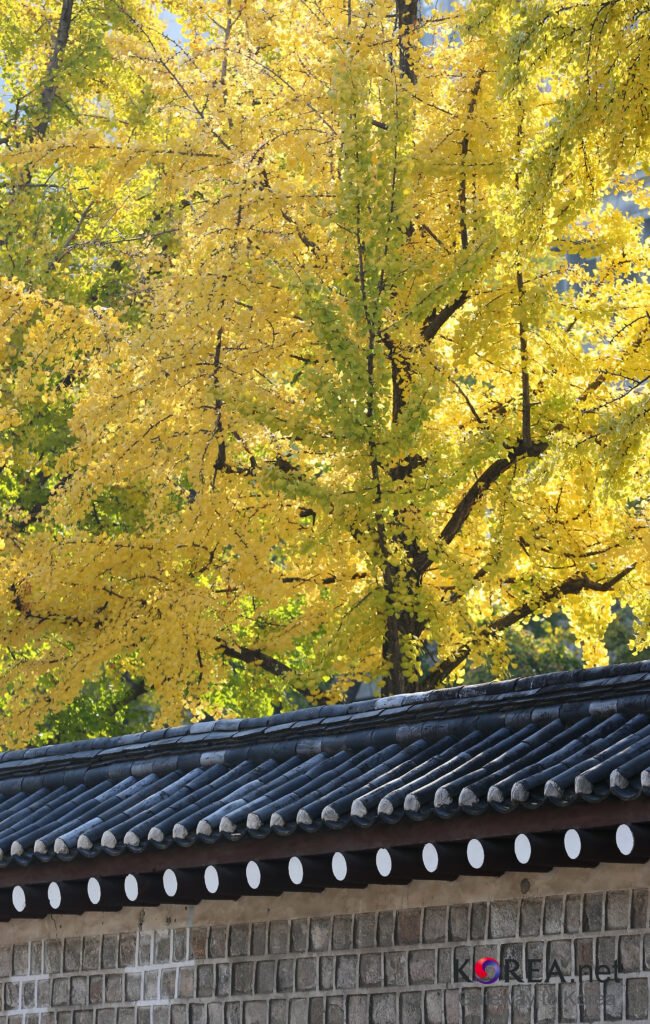
    Yellow ginkgo tree above a tiled palace wall at Gyeongbokgung in Seoul
    Ginkgo over the wall of Gyeongbokgung. Photo: Korea.net / Korean Culture and Information Service (Jeon Han), CC BY-SA 2.0, via Wikimedia Commons
    • Getting there: Gyeongbokgung Station (Line 3) for Gyeongbokgung; Anguk Station (Line 3) for Changdeokgung
    • Secret Garden cost: Normally ₩5,000 for the garden plus ₩3,000 for the palace ticket (adults 19–64). The free-entry period doesn’t include the special garden tour.
    • English tours of the Secret Garden: 10:30, 11:30, 14:30 and 15:30 (March–November), 100 people per tour: 50 tickets online, 50 on site
    • Booking: Online from 10 a.m. six days before your visit until the day before, or on site from 9 a.m. on the day. The palace warns that October–November tickets sell out very fast.
    • Closed: Changdeokgung closes on Mondays

    Namsan

    Namsan is the hill under N Seoul Tower, and its tree-lined walking roads are free. You can climb on foot from Myeongdong and eat there before or after.

    Seoul Forest

    Seoul Forest is a large, flat park by the Han River near Seongsu, good for an easy walk under the trees with no climbing. Get off at Seoul Forest Station on the Suin-Bundang Line.

    Haneul Park

    Haneul Park is about silver grass rather than red leaves. This year’s Seoul Silver Grass Festival ran October 17–23 and is over, but the park is still open. From World Cup Stadium Station or Mapo-gu Office Station (Line 6), it’s about a 40-minute walk, or you can take the small electric shuttle from the Nanjicheon Park parking lot.

    Day Trips from Seoul for Fall Foliage

    Nami Island

    Nami Island is a small river island crossed by long avenues of trees, including rows of ginkgo and maple.

    • Getting there: ITX-Cheongchun train from Yongsan (about 60 minutes) or Cheongnyangni (about 42 minutes) to Gapyeong Station. From the station it’s 1.5 km to the ferry wharf: about 20 minutes on foot, or 5 minutes by bus No. 10-4 or taxi.
    • Cost: ₩19,000 for adults, including the round-trip ferry. Early-bird tickets, bought and boarded before 8:00, are ₩13,000.
    • Ferry: The ferry ride takes about 5 minutes. In the autumn season (September 18–November 22), the first ferry leaves at 07:30 every day, and the last ferry runs until 21:30 on Fridays, weekends and holidays.
    • Tip: Catch an early ferry before 8:00 and you pay the early-bird price and get a head start on the day.

    Hwadam Forest (Hwadam Botanic Garden)

    Hwadam Forest is a landscaped forest garden southeast of Seoul, with maple valleys and wooden walking decks. Unlike everywhere else in this guide, you can’t just turn up.

    • Booking: Entry is by advance reservation only, through the NOL (Nol Universe) app or website, and you need a NOL account. Kiosk tickets on site are sold only if any are left.
    • Hours: October 23–November 1: daily 08:00–18:00 (last entry 17:00). November 2–15: daily 08:00–17:00 (last entry 16:00).
    • Cost: ₩11,000 for adults (19–64). The monorail costs extra: ₩5,000, ₩7,000 or ₩9,000 for adults, depending on the section.
    • Getting there: Gyeonggang Line to Gonjiam Station, then a taxi or Gwangju bus 9 (about 30 minutes). Express buses 1113-1 and 500-2 from Gangbyeon Station, or 500-1 from Jamsil Station, go to Gonjiam Terminal.

    Seoraksan National Park

    Seoraksan is the first big mountain to turn every year, and in 2026 both forecasts put its peak in the past (October 20 per the Korea Forest Service, October 25 per Weatheri). The high ridges will be past their best by now. If you’re already heading to the east coast, check current photos before you commit to the trip.

    • Getting there: Express bus from Seoul to Sokcho, then a local bus or taxi to the park
    • Cost: No entrance fee. The Seorak cable car costs ₩16,000 round trip for adults (middle-school age and up), sold on site only, on the day, with no reservations and no one-way tickets.

    Naejangsan National Park

    If you have time for one more trip this season, make it Naejangsan. It’s known for its maple tunnels and a pavilion on a pond, and its peak is still ahead: November 1 per Weatheri, November 4 per the Korea Forest Service, and around November 7–8 per Jeongeup City, which expected the color to start around October 29.

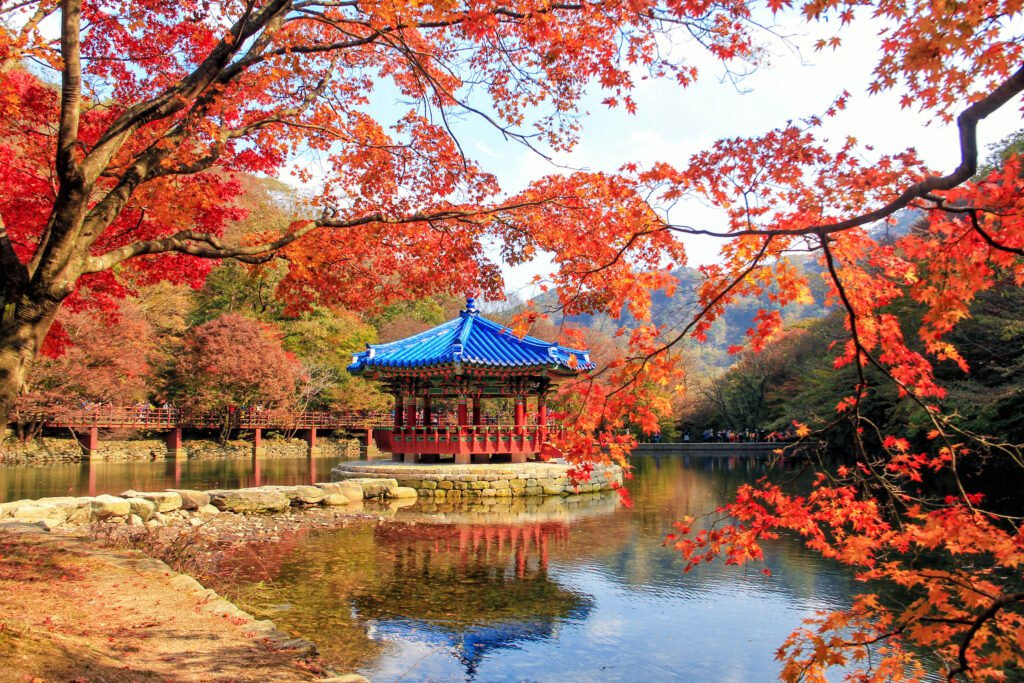
    Pavilion on a pond framed by red maple leaves in Naejangsan National Park
    Naejangsan in autumn. Photo: Tung Thanh Dang, CC BY-SA 3.0, via Wikimedia Commons
    • Getting there: Train from Yongsan to Jeongeup Station, then city bus 171 or 171-1 from Jeongeup Terminal to Naejang Terminal, near the park entrance
    • Free shuttle: October 30–November 15, between Naejangho parking lot (formerly Lot 4) and Wollyeonggyo Bridge (2.1 km). Weekdays 09:00–17:00, weekends 08:00–17:00.
    • Crowds: Jeongeup City has a crowd and traffic plan in place from October 26 to November 22, with its busiest period set for October 31–November 15. Expect heavy weekend traffic.

    Tips for Seeing Fall Foliage in Korea

    • Go on a weekday, and go early. Nami Island, Hwadam Forest and Naejangsan get packed on peak weekends. A weekday morning is much calmer.
    • Book what needs booking now. Hwadam Forest and the Secret Garden tours both sell out in autumn. You can walk into everything else on this list.
    • Check the weather the day before. Heavy rain or strong wind can strip trees in a day. Before the October 18 storm, the KMA even warned that fallen leaves could clog storm drains.
    • Dress in layers. Late-autumn mornings are cold, and mountain trails get colder and windier as you climb. Wear proper shoes for national parks. A light jacket you can take off is enough for city walks.
    • Use Naver Map for transit. It’s more accurate than Google Maps for buses in Korea, including the local buses to Nami Island, Hwadam Forest and Naejangsan.

    Korea Fall Foliage FAQ

    When is peak fall foliage in Korea in 2026?

    It depends on where you are. The Korea Forest Service forecast Seoraksan for October 20, Songnisan for October 28, Naejangsan for November 4 and Hallasan for November 6. Nationwide, it expected ginkgo to peak on October 30 and maples and oaks on October 31.

    Where can I see autumn leaves in Seoul?

    The palaces (Deoksugung, Gyeongbokgung and Changdeokgung’s Secret Garden), Namsan and Seoul Forest are the easiest. All four main palaces are free to enter from October 29 to November 15, 2026.

    Is it too late for fall foliage in Korea in November?

    No. Naejangsan’s forecast peak falls in the first week of November, Weatheri expects Jirisan and the south to peak November 5–13, and Hallasan on Jeju is forecast for November 6. The northern mountains, like Seoraksan, will be past their best by then.

    Do I need to book anything in advance?

    Yes, for Hwadam Forest, which takes advance reservations only through NOL, and for the Changdeokgung Secret Garden tour. Nami Island, the other palaces and the national parks don’t need a booking.