Your local guide to Korea, written in Seoul

Eat, travel and live like a local in Korea

Category: Travel Essentials

Transport, payment, apps, SIM cards and everything you need before and during your trip to Korea.

  • Korea in Winter (December to February): Weather, What to Wear and Things to Do

    Korea in Winter (December to February): Weather, What to Wear and Things to Do

    Short answer: Korea in winter is cold, dry and mostly sunny. In Seoul, January is the coldest month, with an average daily low of −5.5°C (22°F) and a high of just 2.1°C (36°F). Busan and Jeju are several degrees milder. Pack a long padded coat, thermal layers, gloves and shoes with grip. In return you get ski resorts a couple of hours from Seoul, ice fishing festivals, hot street snacks and long evenings at a jjimjilbang.

    Two dates matter if you’re planning a December or January trip. Christmas Day (Friday, December 25, 2026) and New Year’s Day (Friday, January 1, 2027) are public holidays. The Lunar New Year (Seollal) break runs from February 6 to 9, 2027, and that is when trains and highways fill up.

    Last checked: 2026-10-29. Temperatures are the Korea Meteorological Administration (KMA) 1991–2020 climate normals. Holiday dates are from the 2027 calendar announced by the Korea AeroSpace Administration on June 29, 2026. Festival dates are from each festival’s official website. Anything not yet announced is marked as such.

    Korea Winter Weather by Month (Seoul, Busan, Jeju)

    These are 30-year averages, not a forecast. Any given week can be several degrees colder or warmer, and a cold snap in Seoul can push daytime highs well below freezing for a few days.

    Month City Average Average high Average low Precipitation
    December Seoul 0.2°C (32°F) 4.2°C (40°F) −3.4°C (26°F) 22.6 mm
    December Busan 5.8°C (42°F) 10.4°C (51°F) 2.0°C (36°F) 33.8 mm
    December Jeju 8.3°C (47°F) 11.0°C (52°F) 5.6°C (42°F) 55.6 mm
    January Seoul −1.9°C (29°F) 2.1°C (36°F) −5.5°C (22°F) 16.8 mm
    January Busan 3.6°C (38°F) 8.2°C (47°F) −0.1°C (32°F) 34.5 mm
    January Jeju 6.1°C (43°F) 8.6°C (48°F) 3.7°C (39°F) 67.5 mm
    February Seoul 0.7°C (33°F) 5.1°C (41°F) −3.2°C (26°F) 28.2 mm
    February Busan 5.4°C (42°F) 10.2°C (50°F) 1.5°C (35°F) 49.6 mm
    February Jeju 6.8°C (44°F) 9.9°C (50°F) 4.0°C (39°F) 57.2 mm

    Source: KMA climate normals 1991–2020 (data.kma.go.kr), stations Seoul (108), Busan (159) and Jeju (184). Fahrenheit is converted and rounded to the nearest degree.

    What the table means in practice:

    • Seoul drops below freezing most nights from December to February. It is also dry: January averages only 16.8 mm of precipitation, so you get a lot of clear, cold days, and the wind makes it feel colder than the number on the thermometer.
    • Busan is about 5°C warmer than Seoul in January, with lows hovering around freezing. A good coat is still needed, but it’s a gentler winter.
    • Jeju rarely freezes at sea level (January low 3.7°C), but it is the wettest and windiest of the three. Hallasan, the mountain in the middle of the island, is a different story and gets proper snow.
    • Gangwon Province, where most ski resorts are, is colder than Seoul and much snowier, especially in the mountains.
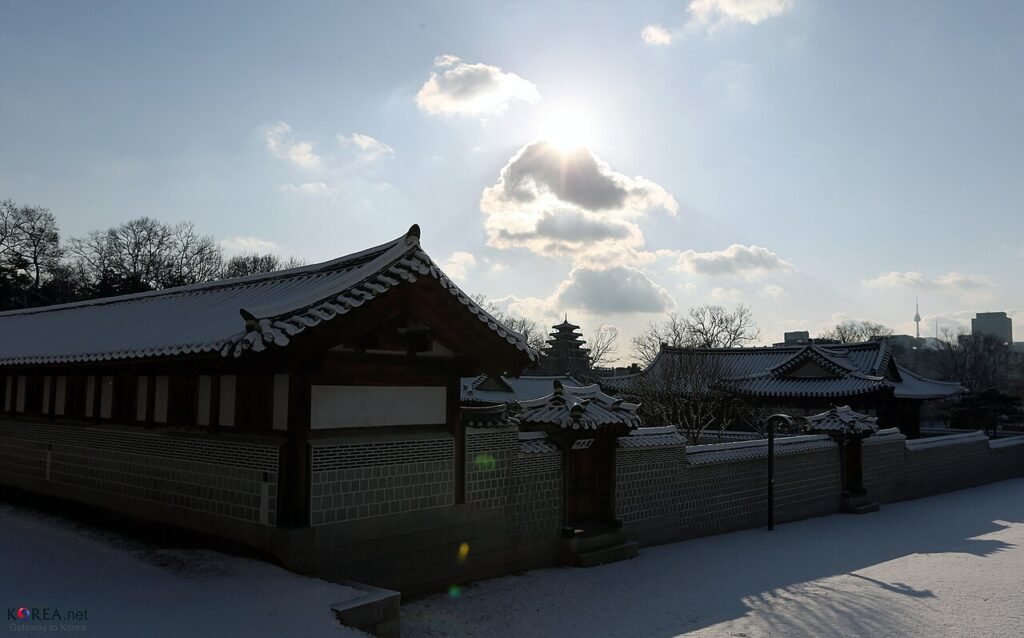
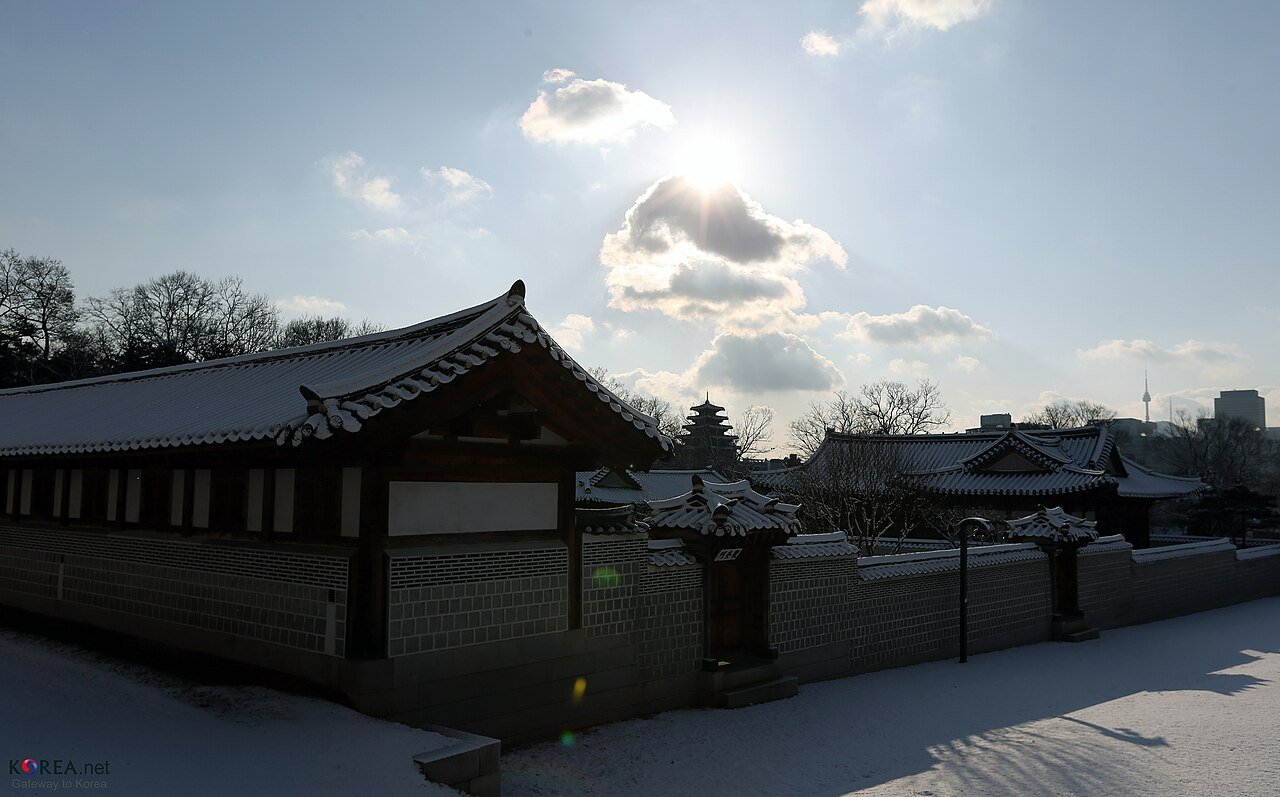
    Snow-covered roofs and walls of Gyeongbokgung Palace in Seoul on a sunny winter morning
    Gyeongbokgung Palace after a December snowfall. Photo: Korea.net / Korean Culture and Information Service (Jeon Han), CC BY-SA 2.0, via Wikimedia Commons

    What to Wear in Korea in Winter

    In a Korean winter you go back and forth between freezing streets and very warm rooms all day. Subway cars, cafes, shops and restaurants with heated floors (ondol) can all feel hot. Wear a warm coat you can take off easily, with thinner layers underneath.

    Packing list for December to February

    • A long padded coat. A knee-length down or synthetic puffer is what most people in Seoul wear, and it keeps your legs warm in the wind. A short ski jacket is fine for Busan or Jeju.
    • Thermal base layers. A thin thermal top and leggings under normal clothes do more than a thick sweater, and they don’t make you overheat indoors.
    • Hat, scarf and gloves. Touchscreen gloves help, since you’ll be checking Naver Map a lot.
    • Shoes with grip. Sidewalks, stairs and palace courtyards get icy after snow. Waterproof boots or sneakers with a good sole are better than smooth-soled fashion boots.
    • Warm socks. Bring an extra pair if you’re going to an ice festival or a ski resort.
    • Hand warmers. Disposable heat packs are sold at convenience stores across Korea, so you don’t need to pack many.
    • Lip balm and moisturizer. The air outside is dry, and indoor heating dries it out further.

    December vs. January vs. February

    December starts cool and gets colder. Early in the month a warm jacket and layers are often enough in Seoul. By late December and through January you’ll want the full setup above. February is still cold, especially in the first half, but averages a few degrees higher than January.

    Things to Do in Korea in Winter

    Ski and snowboard near Seoul

    Korea has a compact ski scene, and several resorts are close enough to Seoul for a day trip:

    • Konjiam Resort (Gwangju, Gyeonggi) and Jisan Forest Resort (Icheon, Gyeonggi), the closest options to Seoul
    • Elysian Gangchon (Chuncheon, Gangwon) and Vivaldi Park (Hongcheon, Gangwon), further east, with bigger mountains
    • Yongpyong Resort and Phoenix Pyeongchang (Pyeongchang, Gangwon), both venues of the 2018 Winter Olympics, best done as an overnight trip

    As of October 29, 2026, the resorts had not posted their 2026–27 opening dates. Several run seasonal shuttle buses from Seoul. Schedules and booking appear on each resort’s own website once the season is confirmed, so check there rather than relying on last year’s timetable. Gear and clothing rental are available on site.

    Ice fishing festivals

    Ice fishing festivals are a big part of winter in Gangwon Province. You sit over a hole in a frozen river and try to catch trout, and many festivals will grill your catch for you on the spot.

    • Hwacheon Sancheoneo Ice Festival (Hwacheon, Gangwon) is the biggest. Its official website lists the 2027 festival for January 9–31, 2027 (23 days). Besides ice fishing, there are snow and ice activities, ice sculptures and lantern-lit streets. Ticket prices for 2027 hadn’t been published when we checked, so look at the official site before you go.
    • Pyeongchang Trout Festival (Pyeongchang, Gangwon) is a smaller alternative that also offers ice fishing and sledding on a frozen river. Check its official channels for dates.

    All of these depend on the ice being thick enough, so schedules can change in a mild winter.
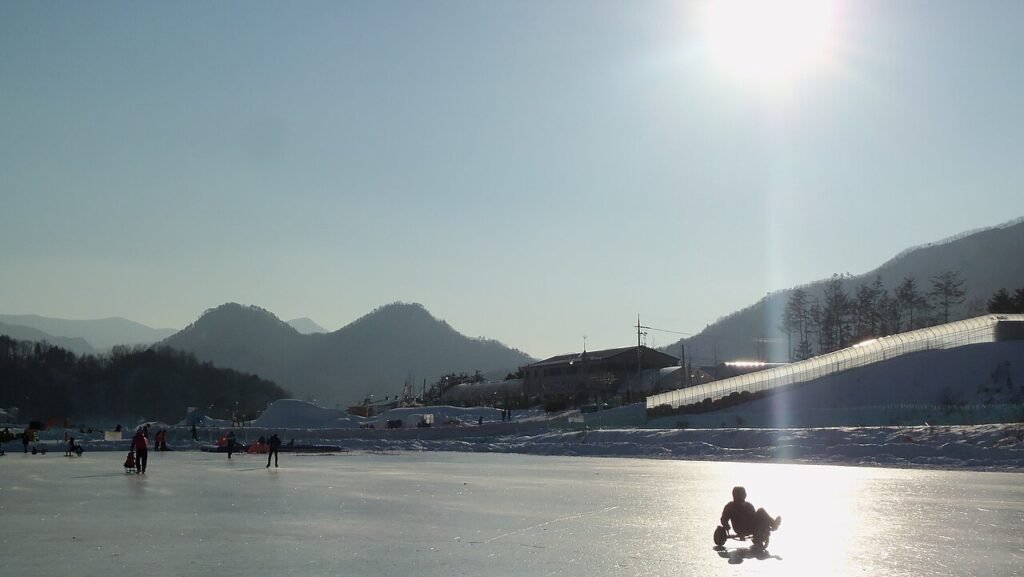
    People sledding and walking on a frozen river under winter sun at a trout festival in Pyeongchang, Korea
    A frozen river at the Pyeongchang Trout Festival. Photo: Christian Bolz, CC BY-SA 4.0, via Wikimedia Commons

    Christmas and New Year in Seoul

    Seoul decorates heavily for the holidays, with light displays and markets around the city center, especially near Gwanghwamun and Cheonggyecheon. As of October 29, 2026, the city had not announced dates for this year’s events. Check Visit Seoul (english.visitseoul.net) from late November for the confirmed schedule. If you want to see in the New Year, expect big crowds in central Seoul on December 31.

    Winter street food

    A lot of Korean snacks mostly appear once it gets cold. Look for small street carts and market stalls:

    • Hotteok: a griddle-fried pancake filled with brown sugar, cinnamon and nuts. Bite carefully, because the syrup inside is very hot.
    • Bungeoppang: a fish-shaped waffle filled with sweet red bean paste, and sometimes custard.
    • Gyeran-ppang: a small sweet bread with a whole egg baked on top.
    • Eomuk: fish cake skewers simmered in broth. You can usually sip the broth from a paper cup while you eat.
    • Roasted sweet potatoes and chestnuts from barrel roasters on the street.
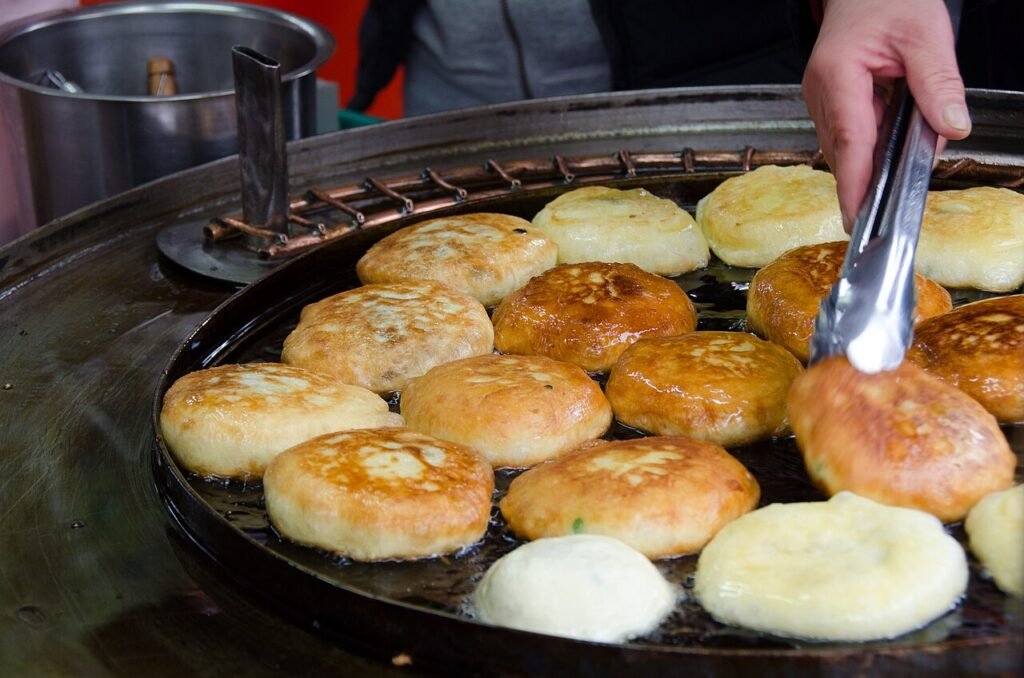
    Hotteok, Korean sweet pancakes, frying on a round griddle at a street stall
    Hotteok on the griddle. Photo: Sandra Vallaure, CC BY 2.0, via Wikimedia Commons

    Warm up at a jjimjilbang

    A jjimjilbang is a Korean bathhouse with gender-separated baths, plus shared heated rooms where everyone wears the provided T-shirt and shorts. After a cold day of walking, it’s a cheap and easy way to warm up. Bathing areas are nude, so leave your swimsuit at home. Prices and opening hours vary by place, so check before you go.

    Indoor backups for the coldest days

    On days when the wind makes walking miserable, plan around indoor places: museums, underground shopping streets near subway stations, covered markets, and cafes. Seoul’s palaces are still worth a visit after snow, but keep it to an hour or two.

    Holidays and Crowds: Dates to Watch

    Date Holiday What it means for travelers
    Fri, Dec 25, 2026 Christmas Day (public holiday) Busy evening in shopping and nightlife areas. It’s more of a date night than a family holiday in Korea.
    Thu, Dec 31, 2026 New Year’s Eve (not a public holiday) Big crowds in central Seoul around midnight.
    Fri, Jan 1, 2027 New Year’s Day (public holiday) Some people head out early to watch the first sunrise of the year.
    Sat, Feb 6 to Tue, Feb 9, 2027 Seollal (Lunar New Year), with Feb 9 as a substitute holiday The biggest travel period of the winter. Trains and intercity buses sell out, and many small family-run restaurants and shops close for a day or more.

    Source: 2027 calendar announced by the Korea AeroSpace Administration (June 29, 2026). Seollal itself falls on Sunday, February 7, 2027.

    If your trip overlaps Seollal, book KTX trains and long-distance buses as early as you can, and avoid moving between cities on the first and last day of the break. In Seoul, the days of Seollal are actually fairly quiet, as many residents go to their hometowns, but check opening days for any specific restaurant or attraction you plan to visit.

    Tips for a Winter Trip to Korea

    • Check the weather every evening. Cold snaps come and go in Korea. The KMA app or Naver Weather shows the “feels like” temperature, which is the more useful number.
    • Look at the air quality too. Some winter days have high fine dust (misemeonji) levels. Naver Weather shows it next to the forecast. If it’s bad, a KF94 mask from any convenience store helps.
    • Days are short. It gets dark in the late afternoon in December and January, so start early if you’re doing a day trip.
    • Use Naver Map for transit. It’s more accurate than Google Maps for buses and walking routes in Korea.
    • Keep phone batteries warm. Cold drains them fast at ski resorts and ice festivals. Carry a power bank in an inside pocket.

    Korea in Winter FAQ

    How cold is Korea in winter?

    In Seoul, the coldest month is January, averaging −1.9°C (29°F), with average lows of −5.5°C (22°F), according to the KMA’s 1991–2020 normals. Busan averages 3.6°C (38°F) in January and Jeju 6.1°C (43°F).

    Is December or January better for visiting Korea?

    December is a little milder and has the holiday lights and Christmas atmosphere. January is colder but is the main season for ice festivals like Hwacheon (January 9–31, 2027) and for skiing. Both avoid the Seollal rush in February 2027.

    Does it snow in Seoul in winter?

    Yes, but not often heavily, and it rarely stays on the ground for long. Seoul’s winter is mostly dry, with only 16.8 mm of average precipitation in January. For reliable snow, head to the ski resorts in Gangwon.

    What should I wear in Seoul in January?

    A long padded coat, thermal base layers, a hat, gloves, a scarf and shoes with good grip. Dress in layers you can take off, because buildings and subways are well heated.

    When is Seollal in 2027?

    Seollal falls on Sunday, February 7, 2027. The public holiday runs from February 6 to 9, including a substitute holiday on Tuesday, February 9.
  • Incheon Airport to Seoul (2026): Every Way to Get There, With Current Fares

    Incheon Airport to Seoul (2026): Every Way to Get There, With Current Fares

    Short answer: for most first-time visitors, the cheapest easy way from Incheon Airport to Seoul is the AREX All-Stop train (₩4,750 from Terminal 1 to Seoul Station, about US$4). If you’re staying near Myeongdong, Gangnam or Jamsil and have big suitcases, the airport limousine bus (₩17,000–18,000, about US$13–14) drops you near your hotel with no stairs or transfers. Landing after 11 p.m.? Night buses run until about 5 a.m., or take a taxi from the official stand.

    I’m a Seoul local, and I took every fare, first and last departure and boarding spot below from the operators’ own websites. Several popular English guides still quote old AREX Express prices, and the adult fare has gone up since.

    Last checked: 2026-10-29. Fares and times are from AREX (airportrailroad.com), Incheon Airport (airport.kr), Airport Limousine (airportlimousine.co.kr), K-Limousine (klimousine.com) and International Taxi (intltaxi.co.kr). Schedules change, so check the operators’ sites before you go. US dollar amounts use Naver’s base exchange rate on 2026-10-28 (₩1,332.80 = US$1), rounded.

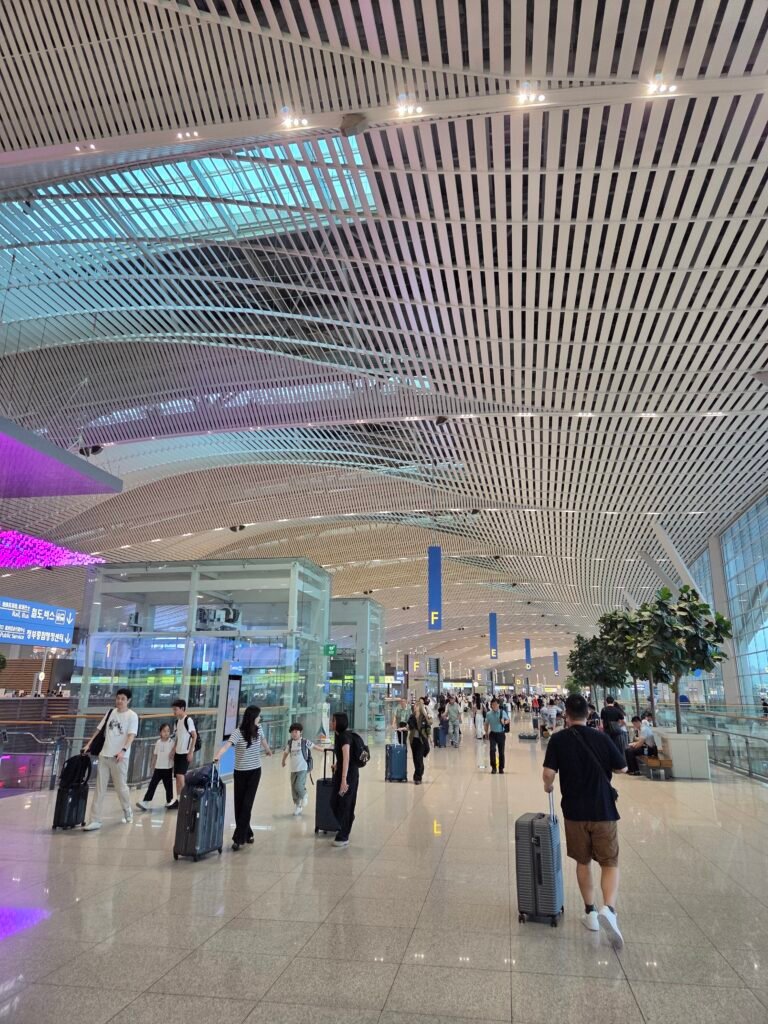
    Travelers with suitcases inside Incheon International Airport Terminal 2
    Incheon International Airport Terminal 2. Photo: Jimmy

    Incheon Airport to Seoul: All Options Compared

    Option Adult fare Time Runs (from the airport) Best for
    AREX Express train ₩13,000 (~US$10) 43 min (T1) / 51 min (T2) to Seoul Station 05:16 (T2) – 22:48 (T1) Fast, guaranteed seat, hotels near Seoul Station
    AREX All-Stop train ₩4,750 (T1) / ₩5,350 (T2) to Seoul Station (~US$4) 59 min (T1) / 66 min (T2) to Seoul Station 05:08 (T2) – 23:56 (T1) Budget, Hongdae, light luggage
    Airport limousine bus ₩17,000–18,000 (~US$13–14) Depends on traffic About 5 a.m. to 11 p.m., by route Heavy luggage, hotels on the route
    Night bus Varies by route Depends on traffic About 11:20 p.m. to 5 a.m. Late-night arrivals on a budget
    Regular taxi Meter, from ₩4,800 base (~US$4) plus tolls Depends on traffic 24 hours Groups, door to door
    International Taxi (pre-booked) Flat ₩70,000–95,000 by Seoul zone (~US$53–71) Depends on traffic Book ahead No Korean needed, fixed price

    T1 and T2 are Terminal 1 and Terminal 2. Your boarding pass or airline website tells you which one you land at. Both have the train station and the bus stops, but the buses and trains leave from different places in each one.

    Before You Leave the Airport: Get a T-money Card

    T-money is Korea’s rechargeable transit card. You tap it on the subway, the AREX All-Stop train, city buses and many taxis. AREX says prepaid cards are sold at transit card outlets such as convenience stores, so pick one up at a convenience store in the arrivals area or near the train station, then load it at a ticket machine. Bring some won in cash for loading it.

    Two exceptions: the AREX Express train needs its own ticket, and some limousine buses want a ticket bought before you board (details below).

    1. AREX Express Train (Fastest to Seoul Station)

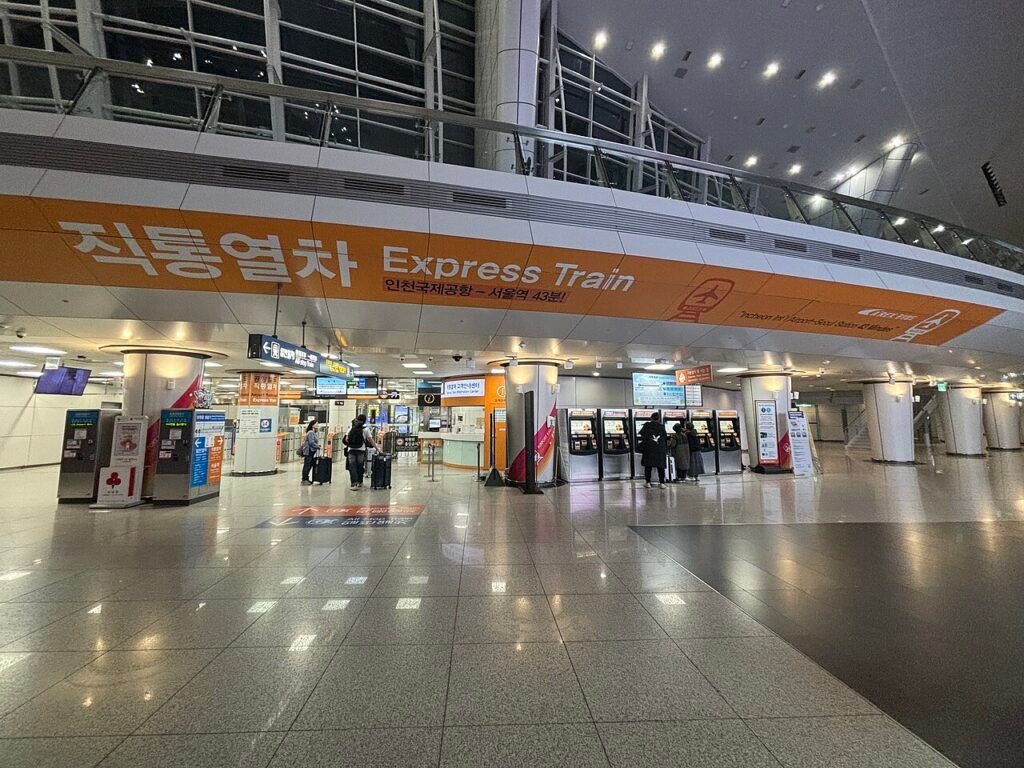
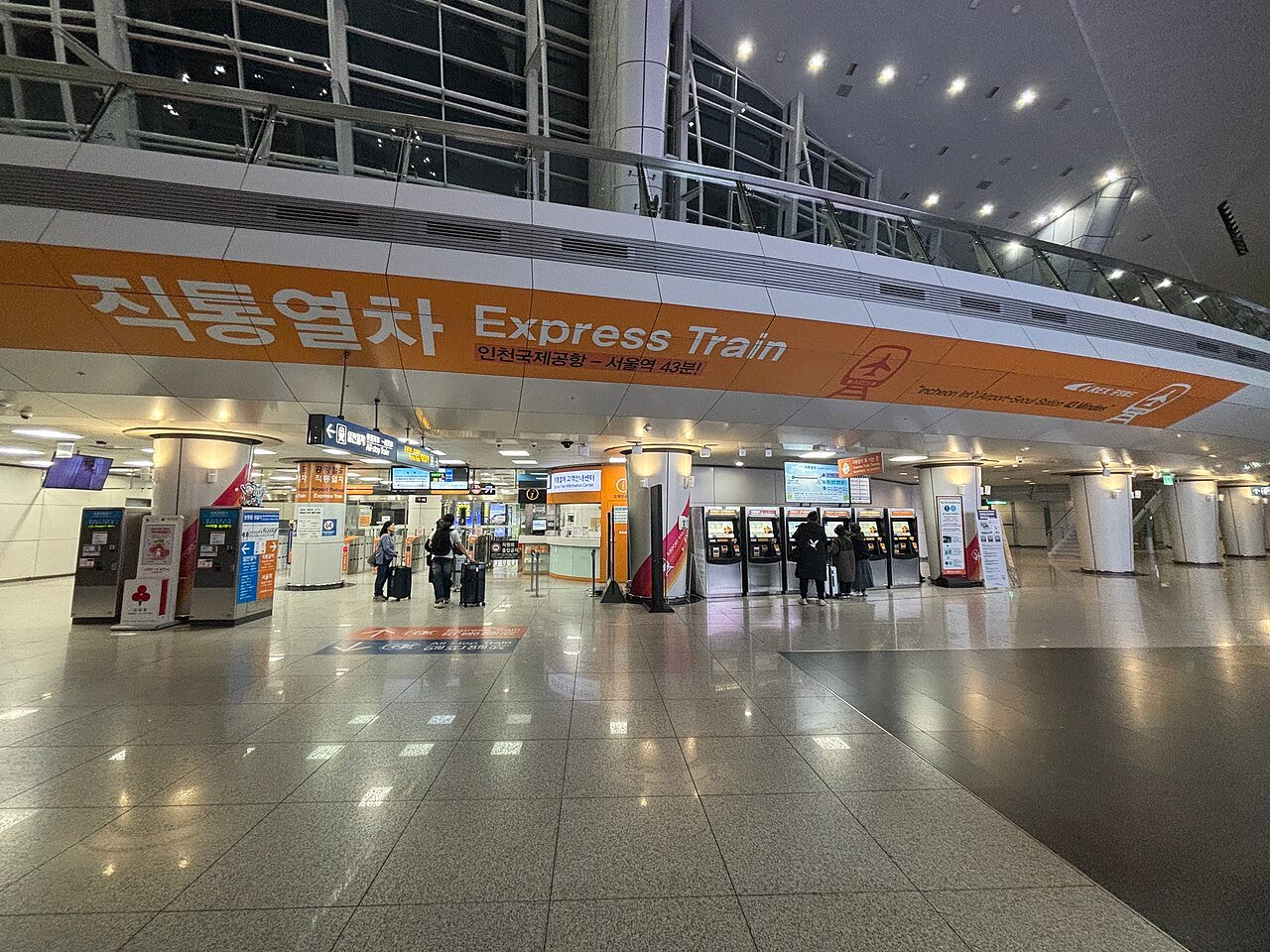
    The Express is a nonstop train between the airport and Seoul Station with assigned seats, free Wi-Fi and staff on board. It stops nowhere else, so it only makes sense if Seoul Station is where you’re going or where you’ll change trains.

    AREX Express Train ticket area and gates at Incheon International Airport Terminal 1 Station
    The Express Train concourse at Incheon Airport Terminal 1 Station. Photo: MNXANL, CC BY-SA 4.0, via Wikimedia Commons
    • Fare: ₩13,000 for adults (about US$10) and ₩9,500 for children aged 6–12 (about US$7). AREX lists ₩18,500–19,100 as the “regular” fare, but ₩13,000 is what adults pay right now.
    • Time: 43 minutes from Terminal 1, 51 minutes from Terminal 2 to Seoul Station.
    • First and last trains: 05:16 from T2 and 05:24 from T1; the last ones leave at 22:40 from T2 and 22:48 from T1. Same times on weekends.
    • Where to board: the Transportation Center, basement level 1 (B1), at both terminals. Follow the orange “Express Train” signs.
    • How to pay: buy a ticket online at airportrailroad.com, at the ticket machines, or at the Express Train customer center on B1. Foreign Visa, Mastercard, JCB, Diners, Amex and UnionPay cards are accepted. You can’t just tap T-money.
    • Luggage tip: T1 station runs an electric cart service. At Seoul Station you’ll need to transfer to the subway for most hotels, which means escalators and long walks with your bags.

    2. AREX All-Stop Train (Cheapest, and Direct to Hongdae)

    The All-Stop is a normal commuter train on the same line. It’s slower but costs about a third of the Express, and it stops at Hongik University Station (Hongdae), Gongdeok and Gimpo Airport on the way to Seoul Station.

    • Fare with T-money: ₩4,750 from T1 and ₩5,350 from T2 to Seoul Station; ₩4,650 from T1 and ₩5,250 from T2 to Hongik University (about US$3–4).
    • Single-journey card: if you don’t have T-money, buy a one-time card at the station machine. It costs ₩100 more per trip plus a ₩500 deposit you get back at your destination.
    • Time: 59 minutes from T1 and 66 minutes from T2 to Seoul Station (some trains take 2–6 minutes longer).
    • First and last trains: first at 05:08 from T2 and 05:14 from T1. The last trains that reach Seoul Station leave at 23:32 from T2 and 23:38 from T1. After that, one more train (23:50 from T2, 23:56 from T1) goes only as far as Digital Media City and does not reach Hongdae.
    • Where to board: the same B1 Transportation Center, but the All-Stop has its own gates. Tap in like the subway.
    • Luggage tip: it’s a commuter train, so closer to Seoul it can fill up at rush hour. Keep your suitcase beside you, out of the doorway.

    AREX Express vs All-Stop: which one?

    Take the Express if you’re going to Seoul Station itself, want a guaranteed seat after a long flight, or are traveling at rush hour. Take the All-Stop if you’re on a budget, heading to Hongdae or Gongdeok, or carrying only a carry-on. The time difference to Seoul Station is about 15 minutes.

    3. Airport Limousine Bus (Easiest With Big Luggage)

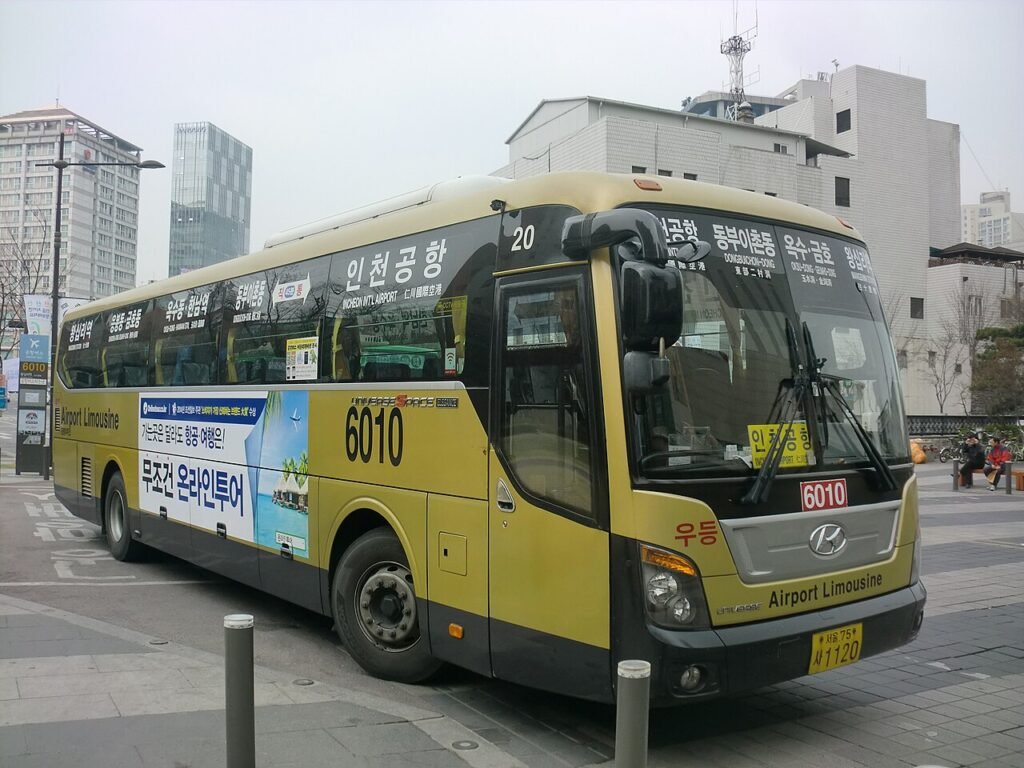
    Limousine buses are comfortable coaches that run from the airport to hotels and stations all over Seoul. The driver loads your bags underneath, and there are no stairs or transfers. Traffic decides how long the ride takes, so allow extra time at rush hour.

    Gold Airport Limousine bus bound for Incheon Airport at a stop in Seoul
    An Airport Limousine bus in Seoul. Photo: hyolee2, CC BY-SA 3.0, via Wikimedia Commons

    Two companies run the main routes, and they work differently:

    • Airport Limousine (6001, 6002, 6015): ₩17,000 adults, ₩12,000 children (about US$13 / US$9). At Terminal 1 it’s first come, first served, and you can pay with cash, T-money or a ticket. At Terminal 2 you must buy a ticket first at the ticket booth or a kiosk.
    • K-Limousine (6703, 6705A): ₩18,000 adults, ₩12,000 children aged 6–12 (about US$14 / US$9). From the airport, buy your ticket in advance at the ticket booth or kiosk.

    Main routes from the airport

    Route Goes to T1 stop / times T2 stop / times
    6015 Mapo, Gongdeok, Namdaemun Market, Euljiro hotels, Myeongdong Station 5B-2 · 05:39–23:19 (weekdays) B1 No. 28 · 05:19–22:59 (weekdays)
    6001 Seoul Station, Hoehyeon (Namdaemun Market), Myeongdong Station, Dongdaemun DDP 5B-4 · 05:29–23:09 B1 No. 29 · 05:39–22:49
    6002 Hapjeong, Hongik Univ. (Hongdae), Sinchon, Gwanghwamun, Jongno, Dongdaemun 6A-1 · 05:34–23:29 (weekdays) B1 No. 30 · 05:14–23:09 (weekdays)
    6703 Sinnonhyeon, Seonjeongneung, COEX, Samseong Station, Seolleung (Gangnam) 3B · 06:15–22:55 B1 No. 18/19 · 05:55–22:35
    6705A Jamsil Lotte World, Dong Seoul Terminal (Gangbyeon), Gwangnaru, Walkerhill 4A · 05:20–23:15 B1 No. 18/19 · 05:00–22:55
    • Where to buy tickets: at Terminal 1, ticket booths are inside the arrivals hall near exits 4 and 9, with more just outside near exits 4, 6, 7, 8, 11 and 13. At Terminal 2, the ticket booth and kiosks are on B1 in the Transportation Center. Kiosks run 24 hours.
    • Check your stop on Naver Map: type your hotel into Naver Map and look at the bus options. If a 60xx or 67xx bus stops within a few minutes’ walk, that’s usually your easiest ride.
    • November 1 detours: both bus companies have posted notices about detours and skipped stops on Sunday, November 1, 2026, the day of the JTBC Seoul Marathon. If you land that day, ask at the ticket booth.

    4. Taxi (Regular, Deluxe and International Taxi)

    Use only the official taxi stands outside arrivals. The airport warns that people posing as taxis inside the terminal often overcharge. Taxis from Incheon Airport to Seoul don’t charge a city-boundary surcharge, but you pay the expressway tolls on top of the meter.

    • Regular (standard) taxi: base fare ₩4,800 (about US$4), then metered. Seoul-bound stands are 5C, 6C and 6D at T1 and 7C at T2. Night surcharge: 20% from 22:00–23:00, 40% from 23:00–02:00, and 20% from 02:00–04:00.
    • Deluxe (black) and jumbo 9-seat taxis: base fare ₩7,000 (about US$5), 20% night surcharge from 22:00–04:00. Stands: 7C/8C at T1, 7D at T2. Jumbo taxis are the easy pick for a family with four or more big suitcases.
    • International Taxi: an official taxi service for foreign visitors, with drivers who speak English and other languages. Stands are 4C at T1 and 3C at T2, or book online at intltaxi.co.kr. Rides from the airport to Seoul use a flat zone fare that includes tolls, and you can pay in cash or by Visa, Mastercard or Amex.

    International Taxi flat fares (airport to Seoul)

    Zone Seoul districts (examples) Standard Deluxe / Large
    A Gangseo ₩70,000 (~US$53) ₩100,000 (~US$75)
    B Mapo (Hongdae), Seodaemun, Yeongdeungpo ₩75,000 (~US$56) ₩110,000 (~US$83)
    C Jung-gu (Myeongdong), Jongno, Yongsan ₩85,000 (~US$64) ₩120,000 (~US$90)
    D Gangnam, Seocho, Seongdong, Dongdaemun ₩90,000 (~US$68) ₩130,000 (~US$98)
    E Songpa (Jamsil), Gwangjin, Gangdong ₩95,000 (~US$71) ₩140,000 (~US$105)

    5. Private Transfer or Car

    If you want someone waiting with your name on a sign, the simplest official option is to pre-book the International Taxi online. You choose a standard, deluxe or large van, the fare to Seoul is fixed by zone (table above), and a meet-and-greet sign service is available for an extra fee. Many Seoul hotels also arrange pickups, so check with yours. Kakao T, Korea’s main taxi app, works too, but set it up and test it before you fly.

    Which One Should I Take? By Neighborhood

    • Myeongdong: bus 6015 or 6001 stops right at Myeongdong Station, the easiest ride with luggage. By train, take AREX to Seoul Station, then Line 4 two stops to Myeongdong. International Taxi: Zone C, ₩85,000.
    • Hongdae: the AREX All-Stop goes straight to Hongik University Station with no transfer. At ₩4,650 from T1, it’s the cheapest ride in this guide. Bus 6002 also stops at Hongik Univ. near the Mercure and L7 hotels. International Taxi: Zone B, ₩75,000.
    • Gangnam: bus 6703 covers Sinnonhyeon, COEX and Samseong. The trains don’t go there directly, so with luggage the bus or a taxi is less hassle. International Taxi: Zone D, ₩90,000.
    • Jamsil: bus 6705A runs direct to Jamsil Lotte World. No train goes there without transfers, so with luggage the bus or a taxi is simpler. International Taxi: Zone E, ₩95,000.
    • Near Seoul Station: take the AREX Express and you’re there in 43–51 minutes.

    Arriving Late at Night

    The last AREX Express leaves at 22:48 (T1) and the last All-Stop that reaches Seoul Station at 23:38 (T1). If immigration and baggage take an hour, a flight landing after about 10 p.m. will probably miss the Express. These still run after the trains stop:

    • N6701 (Mapo Station, Seoul Station, Euljiro 1-ga for Myeongdong, DDP): T1 23:50–04:40, T2 23:30–04:20, ₩18,000. T1 stop 6A-2.
    • N6703 (Seorae Village, COEX/Samseong, Jamsil Lotte Hotel World, Dong Seoul Terminal, Gwangnaru): T1 23:40–04:50, T2 23:20–04:30, ₩18,000. T1 stop 3B-4.
    • N6002 (Hongik Univ., Gwanghwamun, Dongdaemun, Cheongnyangni): from T1 stop 6A at 00:00, 00:30, 01:00, 01:40, 04:00 and 04:40; from T2 B1 No. 30 at 23:40, 00:10, 00:40, 01:20, 03:40 and 04:20. Buy a ticket first.
    • N6000 (Songjeong, Yeomchang, Express Bus Terminal): from T1 stop 6A at 00:10, 00:50, 01:30, 02:10, 03:40 and 04:20; from T2 B1 No. 28 at 23:50, 00:30, 01:10, 01:50, 03:20 and 04:00. Buy a ticket first.
    • Taxi: available all night from the official stands. Expect the 20–40% night surcharge on regular taxis.

    Night buses leave less often, sometimes with gaps of over two hours. Check the next departure on a kiosk screen or Naver Map before you decide.

    Using Naver Map From the Airport

    Naver Map is the map app Koreans use, and it handles transit far better than Google Maps here. Search your hotel, tap directions, and it compares the AREX, limousine buses and taxis with live times. Turn on English in the app settings. Download it before you fly and save your hotel so you can find it again with patchy Wi-Fi.

    Incheon Airport to Seoul FAQ

    How much is the AREX Express train in 2026?

    ₩13,000 for adults and ₩9,500 for children (about US$10 and US$7). Older guides that say ₩9,500 or ₩11,000 for adults are out of date.

    Is AREX or the limousine bus better?

    AREX is cheaper and isn’t affected by traffic. The limousine bus costs more but stops near many hotels, so it’s better with heavy luggage or if your hotel is on a bus route and far from a station.

    Can I pay for the airport bus with T-money?

    On Airport Limousine routes 6001, 6002 and 6015 at Terminal 1, yes, and cash also works. At Terminal 2, and on K-Limousine routes from the airport, buy a ticket at the booth or kiosk before boarding.

    How much is a taxi from Incheon Airport to Myeongdong?

    The International Taxi charges a flat ₩85,000 (about US$64) for a standard taxi to Jung-gu, which includes Myeongdong, tolls included. A regular taxi runs on the meter, plus tolls and any night surcharge.

    What if my flight lands after midnight?

    Take a night bus (N6701, N6703, N6002 or N6000) or a taxi from the official stand. AREX trains don’t run between about midnight and 5 a.m.

  • Korea Weather Next Week (Nov 2-8, 2026): Seoul, Busan, Jeju, Incheon & Gangneung + What to Wear

    Korea Weather Next Week (Nov 2-8, 2026): Seoul, Busan, Jeju, Incheon & Gangneung + What to Wear

    Short answer: next week (November 2–8, 2026) looks mostly dry and sunny across Korea. Monday morning brings rain to Busan and Jeju, so pack an umbrella if you’re there. Seoul mornings drop to 3–6°C (37–43°F) while afternoons reach 13–16°C (55–61°F), so dress in layers and bring a warm jacket for early starts and evenings.

    I put this together every Friday for the five places foreign visitors go most: Seoul, Busan, Jeju, Incheon and Gangneung.

    Source: Korea Meteorological Administration (KMA) mid-term forecast, issued Thursday, October 29, 2026 at 06:00 KST. Forecasts more than a few days out can change, so check the latest on weather.go.kr before you head out. Temperatures are lows/highs in °C, with °F in brackets.

    This week at a glance

    • Bring an umbrella on Monday morning (Nov 2) in Busan and Jeju, where the chance of rain is 60%. Seoul, Incheon and Gangneung are cloudy that morning with a 30% chance.
    • Tuesday to Sunday looks sunny almost everywhere.
    • KMA warns that inland areas may swing 10°C or more between morning and afternoon.
    • Busan and Jeju are the warmest, with highs around 18–20°C. Seoul has the coldest mornings, with lows of 3–6°C.

    Seoul Weather Next Week

    Day Sky Chance of rain Low / High
    Mon, Nov 2 Cloudy 30% AM / 10% PM 6 / 14°C (43 / 57°F)
    Tue, Nov 3 Sunny 10% 3 / 13°C (37 / 55°F)
    Wed, Nov 4 Sunny 10% 4 / 14°C (39 / 57°F)
    Thu, Nov 5 Partly cloudy 20% 5 / 16°C (41 / 61°F)
    Fri, Nov 6 Sunny 10% 5 / 15°C (41 / 59°F)
    Sat, Nov 7 Sunny 10% 6 / 14°C (43 / 57°F)
    Sun, Nov 8 Sunny 10% 6 / 14°C (43 / 57°F)

    What to wear in Seoul: it’s a coat-in-the-morning, sweater-by-lunch kind of week. Wear a long-sleeve top with a knit or hoodie, and add a warm jacket or light padded coat for mornings and nights. If you’ll be at Namsan or on the Han River after dark, a scarf helps. No umbrella needed after Monday.

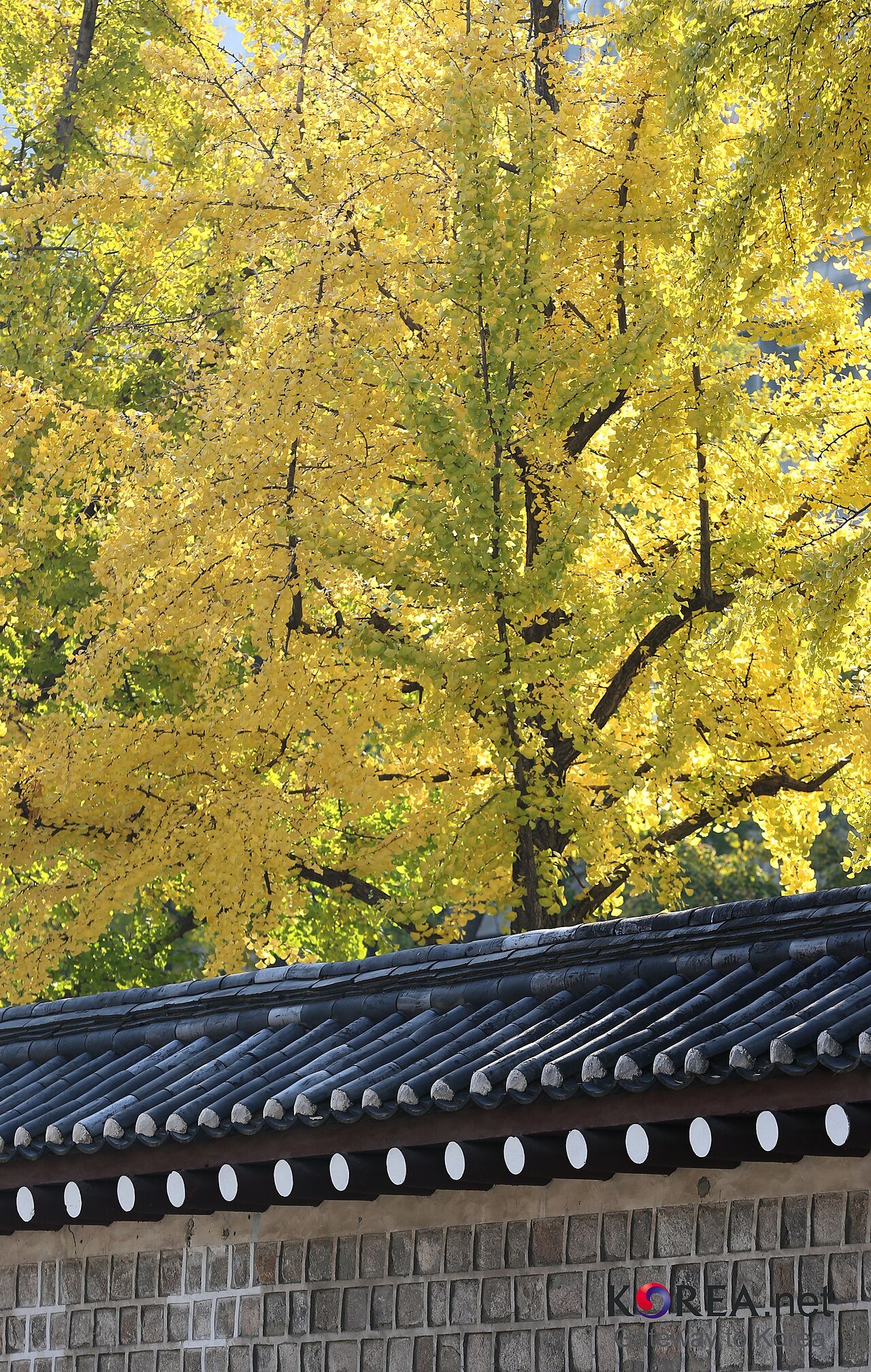
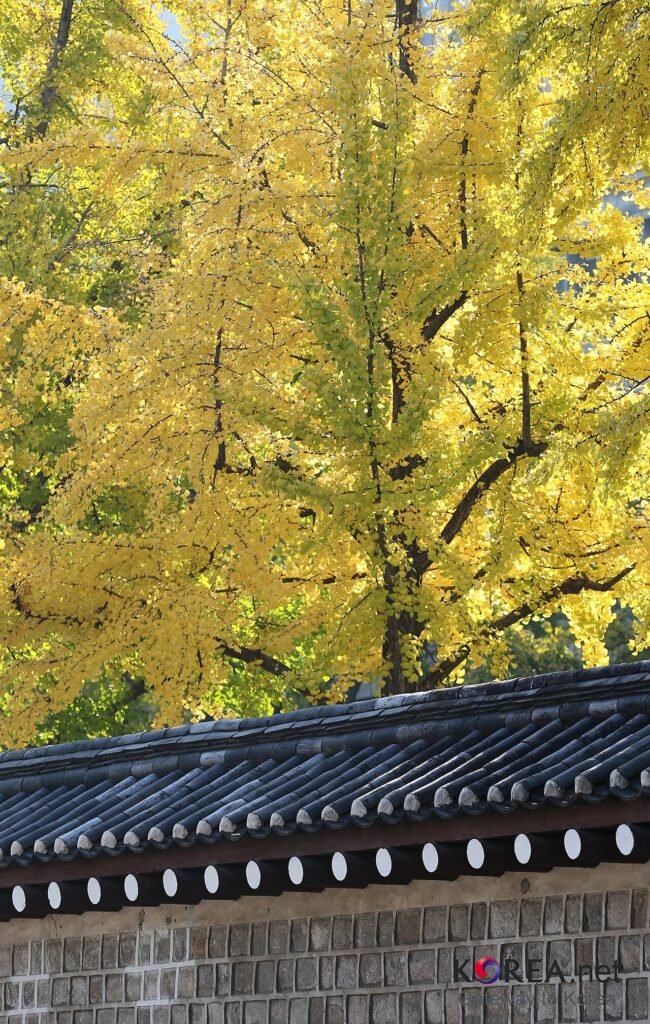
    Yellow ginkgo trees above a traditional palace wall in Seoul in autumn
    Autumn ginkgo trees at Gyeongbokgung Palace, Seoul. Photo: Jeon Han, Korea.net, CC BY-SA 2.0, via Wikimedia Commons

    Incheon Weather Next Week

    Incheon, home to Korea’s main international airport, shares Seoul’s sky but runs a degree or two warmer in the mornings.

    Day Sky Chance of rain Low / High
    Mon, Nov 2 Cloudy 30% AM / 10% PM 8 / 14°C (46 / 57°F)
    Tue, Nov 3 Sunny 10% 5 / 13°C (41 / 55°F)
    Wed, Nov 4 Sunny 10% 5 / 14°C (41 / 57°F)
    Thu, Nov 5 Partly cloudy 20% 6 / 16°C (43 / 61°F)
    Fri, Nov 6 Sunny 10% 6 / 15°C (43 / 59°F)
    Sat, Nov 7 Sunny 10% 7 / 15°C (45 / 59°F)
    Sun, Nov 8 Sunny 10% 7 / 15°C (45 / 59°F)

    What to wear in Incheon: the same layers as Seoul. If you’re landing early in the morning, keep a jacket in your carry-on rather than your checked bag.

    Busan Weather Next Week

    Day Sky Chance of rain Low / High
    Mon, Nov 2 Cloudy with rain 60% AM / 10% PM 14 / 20°C (57 / 68°F)
    Tue, Nov 3 Sunny 10% 7 / 18°C (45 / 64°F)
    Wed, Nov 4 Sunny 10% 8 / 18°C (46 / 64°F)
    Thu, Nov 5 Sunny 10% 9 / 20°C (48 / 68°F)
    Fri, Nov 6 Sunny 10% 10 / 20°C (50 / 68°F)
    Sat, Nov 7 Sunny 10% 10 / 18°C (50 / 64°F)
    Sun, Nov 8 Sunny 10% 10 / 18°C (50 / 64°F)

    What to wear in Busan: bring an umbrella for Monday morning. After that, a long-sleeve shirt with a light jacket covers most of the day. Mornings on Tuesday and Wednesday are cooler (7–8°C), and the wind off the sea at Haeundae or Gwangalli can feel colder than the number suggests.

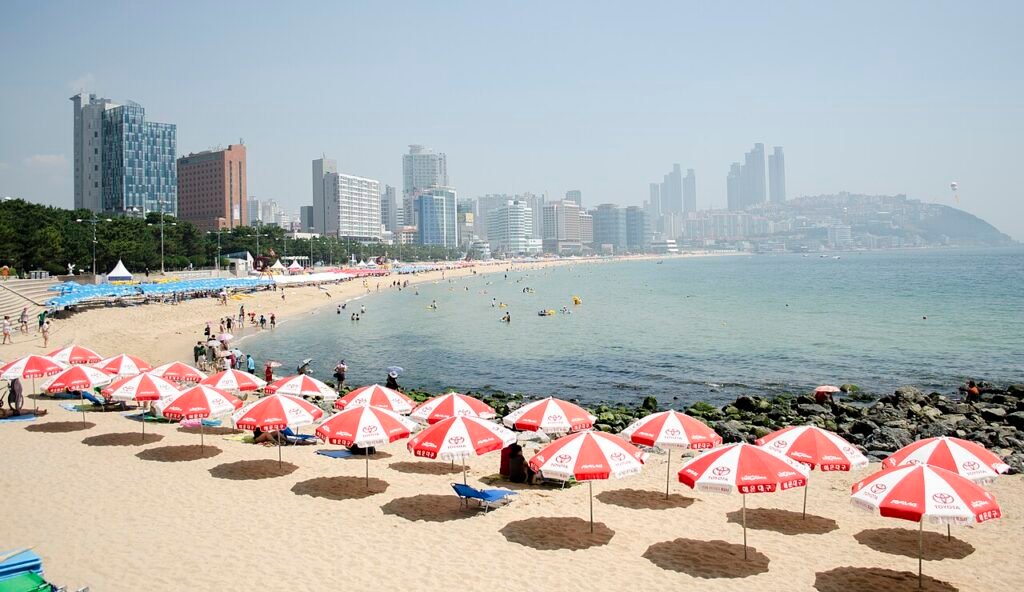
    Haeundae Beach in Busan with the city skyline behind it
    Haeundae Beach, Busan (summer photo). Photo: StephNurnberg, CC BY 2.0, via Wikimedia Commons

    Jeju Weather Next Week

    Day Sky Chance of rain Low / High
    Mon, Nov 2 Cloudy with rain 60% AM / 20% PM 16 / 19°C (61 / 66°F)
    Tue, Nov 3 Sunny 10% 12 / 18°C (54 / 64°F)
    Wed, Nov 4 Sunny 10% 13 / 18°C (55 / 64°F)
    Thu, Nov 5 Sunny 10% 13 / 19°C (55 / 66°F)
    Fri, Nov 6 Sunny 10% 13 / 19°C (55 / 66°F)
    Sat, Nov 7 Sunny 10% 13 / 20°C (55 / 68°F)
    Sun, Nov 8 Sunny 10% 13 / 19°C (55 / 66°F)

    What to wear in Jeju: the mildest of the five, with the smallest gap between morning and afternoon. A T-shirt with a light windbreaker works most days. Pack a rain jacket for Monday, and a warmer layer if you’re hiking Hallasan or climbing Seongsan Ilchulbong for sunrise, since it’s colder and windier up high.

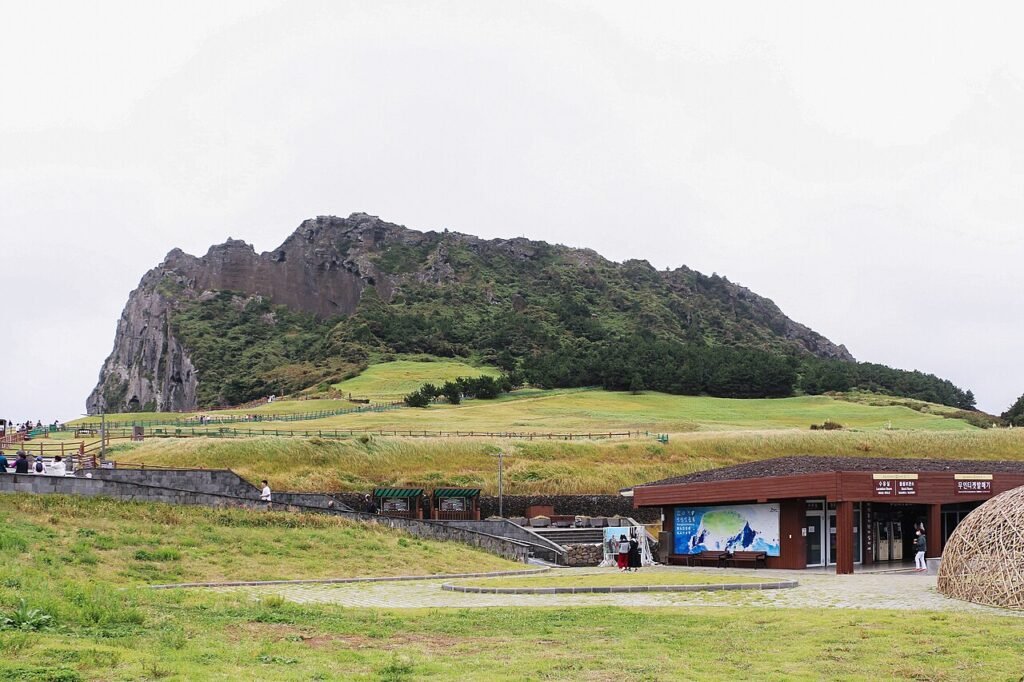
    Seongsan Ilchulbong volcanic cone on Jeju Island under a cloudy sky
    Seongsan Ilchulbong, Jeju. Photo: Bernard Gagnon, CC0, via Wikimedia Commons

    Gangneung Weather Next Week

    Gangneung is on the east coast in Gangwon Province.

    Day Sky Chance of rain Low / High
    Mon, Nov 2 Cloudy 30% AM / 10% PM 11 / 16°C (52 / 61°F)
    Tue, Nov 3 Sunny 10% 7 / 15°C (45 / 59°F)
    Wed, Nov 4 Sunny 10% 7 / 15°C (45 / 59°F)
    Thu, Nov 5 Sunny 10% 8 / 16°C (46 / 61°F)
    Fri, Nov 6 Sunny 10% 9 / 16°C (48 / 61°F)
    Sat, Nov 7 Sunny 10% 8 / 17°C (46 / 63°F)
    Sun, Nov 8 Sunny 10% 9 / 16°C (48 / 61°F)

    What to wear in Gangneung: a sweater and a mid-weight jacket. If you’re going into the mountains, add another layer, as it gets cold quickly once you climb.

    Quick Packing Guide for Korea This Week

    • Layers you can take off by noon and put back on after sunset, wherever you are
    • A warm jacket or light padded coat for Seoul, Incheon and Gangneung mornings and nights
    • A light jacket or windbreaker for Busan and Jeju
    • An umbrella for Monday, mainly in Busan and Jeju. If you forget one, convenience stores sell them.
    • Comfortable shoes, since the rest of the week is dry enough for long walks and hikes

    Korea Weather FAQ

    Will it rain in Seoul next week?

    Probably not much. KMA gives Seoul a 30% chance of rain on Monday morning and 10–20% for the rest of the week.

    What should I wear in Korea in early November?

    Layers. In Seoul, expect around 3–6°C in the morning and 13–16°C in the afternoon, so a warm jacket over a sweater works well. Busan and Jeju are milder, and a light jacket is enough there.

    Is early November a good time to visit Korea?

    For weather, yes. This week is mostly sunny and dry. Just plan for cold mornings and mild afternoons.

    Where can I check the latest Korea weather forecast?

    The Korea Meteorological Administration publishes forecasts in English at weather.go.kr. I update this post every Friday.

  • Korea Travel Checklist 2026: What to Do Before You Fly (From a Local)

    Korea Travel Checklist 2026: What to Do Before You Fly (From a Local)

    Short answer: before you fly to Korea, check whether you need a K-ETA (22 countries and territories, including the US, UK, Canada and Australia, are exempt until December 31, 2026), file the free e-Arrival Card within 3 days of landing, sort out a data plan, and download Naver Map instead of relying on Google Maps. Everything else on this list makes your trip easier, but those four will save you real headaches.

    I’m a Seoul local, and this checklist includes the things Korean friends tell visitors that most English guides skip: restaurant break times, why some BBQ places turn away solo diners, and how to sign up for Naver without a Korean phone number.

    Last checked: 2026-10-27. Entry rules change, so always confirm on the official sites linked below.

    Quick checklist

    • ☐ Passport valid for your whole stay (6+ months is safest)
    • ☐ K-ETA or visa status checked
    • ☐ e-Arrival Card filed (within 72 hours of arrival)
    • ☐ Hotel and train tickets booked
    • ☐ eSIM, SIM or pocket Wi-Fi ready
    • ☐ Naver Map, Papago and Kakao T downloaded
    • ☐ Some cash in won for T-money and markets
    • ☐ Medication rules checked
    • ☐ Plug adapter (Type C/F, 220V)
    • ☐ Emergency numbers saved: 112 and 119

    Korea Travel Checklist: When to Do What

    When What to do
    2–3 months before Check passport validity, check K-ETA or visa needs, book flights and hotels (earlier for spring cherry blossom and autumn foliage seasons)
    1 month before Book KTX train tickets for intercity trips, reserve popular restaurants and attractions, buy travel insurance, check medication rules
    1 week before Buy an eSIM or reserve a SIM or pocket Wi-Fi, download apps, set up your card for overseas use
    Within 3 days of arrival Submit the e-Arrival Card (unless you hold an approved K-ETA)
    On arrival Get some won, buy a T-money card, activate your data

    1. Entry Paperwork: K-ETA and the e-Arrival Card

    Travelers with suitcases walking through Incheon International Airport
    Incheon International Airport. Photo: Jimmy

    K-ETA (Korea Electronic Travel Authorization)

    The K-ETA is an online travel permit for visa-free visitors. Right now, Korea has a temporary K-ETA exemption until December 31, 2026 for 22 countries and territories:

    Australia, Austria, Belgium, Canada, Denmark, Finland, France, Germany, Hong Kong, Italy, Japan, Macau, the Netherlands, New Zealand, Norway, Poland, Singapore, Spain, Sweden, Taiwan, the United Kingdom and the United States (including Guam).

    If your country is not on this list and you don’t need a visa, you’ll likely need a K-ETA. Apply only on the official site, k-eta.go.kr, and do it at least 72 hours before your flight. Copycat sites charge extra for the same form.

    Traveling in 2027? The exemption ends on December 31, 2026 unless Korea extends it again. If your trip is in January 2027 or later, check the official site a few weeks before you fly.

    e-Arrival Card

    The paper arrival card you used to fill out on the plane has been replaced by an online version. Submit it free at e-arrivalcard.go.kr up to 3 days before you land. You don’t need to print it.

    If you already have an approved K-ETA, you can skip the e-Arrival Card. That’s one reason some exempt travelers still choose to apply for a K-ETA.

    Passport

    Your passport needs to be valid for your stay, but many airlines and embassies recommend at least six months of validity. If yours expires soon, renew it before booking anything.

    2. Bookings to Make Early

    • Hotels: Spring (late March to early April) and autumn (October to November) are busy. Book a month or more ahead for those seasons.
    • KTX trains: Weekend and holiday trains between Seoul and Busan sell out. Korean holidays like Chuseok and Seollal are the worst. Avoid traveling on those dates if you can.
    • Popular restaurants: Many trendy restaurants in Seoul take bookings only through Korean apps like CatchTable or put you on a digital waitlist through Tabling. Some now have English versions, so check before you go.
    • Palaces and museums: Check closing days. Gyeongbokgung Palace closes on Tuesdays, and many museums close on Mondays.

    3. Phone, Data and the Apps You Actually Need

    Get mobile data before you land

    An eSIM is the easiest option if your phone supports it. You can also pick up a physical SIM or pocket Wi-Fi at Incheon Airport. You’ll use data all day for maps, translation and payment, so don’t rely on café Wi-Fi.

    Download these apps at home

    • Naver Map: the map Koreans actually use. It has an English mode, walking directions, subway and bus routes, and real reviews.
    • Papago: a translation app made in Korea. Its camera mode is great for menus.
    • Kakao T: for calling taxis.
    • Subway app: Naver Map covers this, but a dedicated subway app is handy underground.
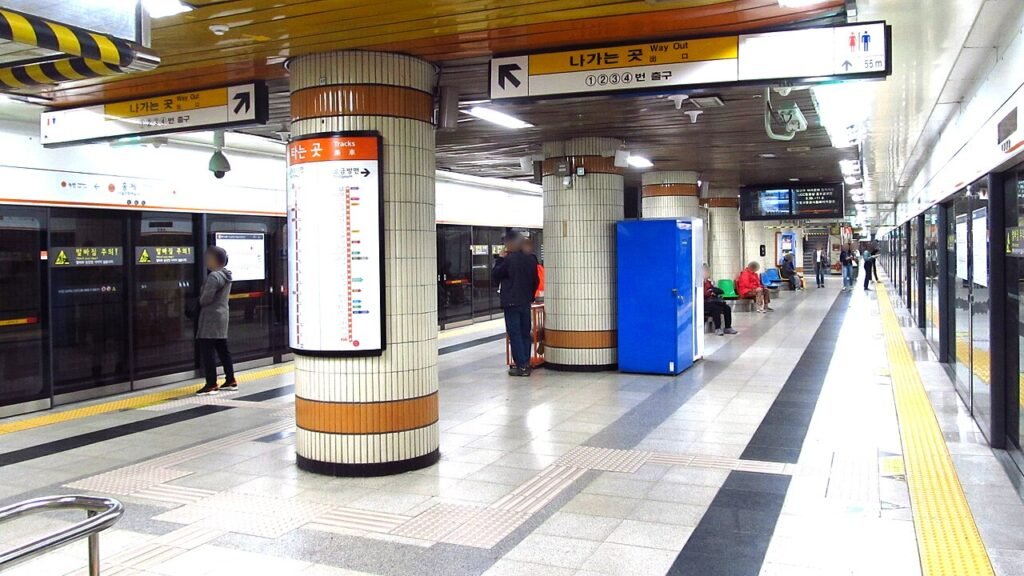
    Seoul subway platform with bilingual Korean and English signs
    A Seoul subway platform. Naver Map shows when the next train arrives. Photo: LERK, CC BY-SA 4.0, via Wikimedia Commons

    Why not just use Google Maps?

    For years, Google Maps couldn’t give proper walking or driving directions in Korea because of map data rules. In February 2026 Korea conditionally approved Google’s request to use detailed map data, but as of this update the full service hasn’t been confirmed as live. For now, Naver Map is still more accurate for walking routes, opening hours and reviews.

    Local tip: Naver Map works best when you search in Korean. Copy the Korean name of a place (from a blog, Instagram or this site) and paste it into the search bar. You’ll get far better results than with an English spelling.

    Jimmy’s note: Skip Google Maps and download Naver Map instead. It’s built around Korean, so translating a place name into Korean before you search usually gives you better results. Most Koreans still use Naver, our own search engine, instead of Google, and that’s why many visitors find getting around frustrating at first. But once you start using Naver Map, you can find great local restaurants and see exactly when the next subway or bus will arrive in real time, so you can plan your day much better.

    Can foreigners sign up for Naver?

    Yes, and you don’t need a Korean phone number.

    • Sign up with your own number: Naver accepts overseas mobile numbers for text-message verification.
    • Verify with your passport: Since June 4, 2026, foreign visitors can verify their identity with a foreign passport right on their phone. Once verified, you can make restaurant reservations, book other services and pay through Naver Map. Before this, travelers without a Korean number had to call customer support.
    • No account needed for the basics: Searching for places and getting directions on Naver Map work without signing up.

    4. Money: Cash, Cards and Tax Refunds

    GS25 convenience store in Seoul with an ATM at the entrance
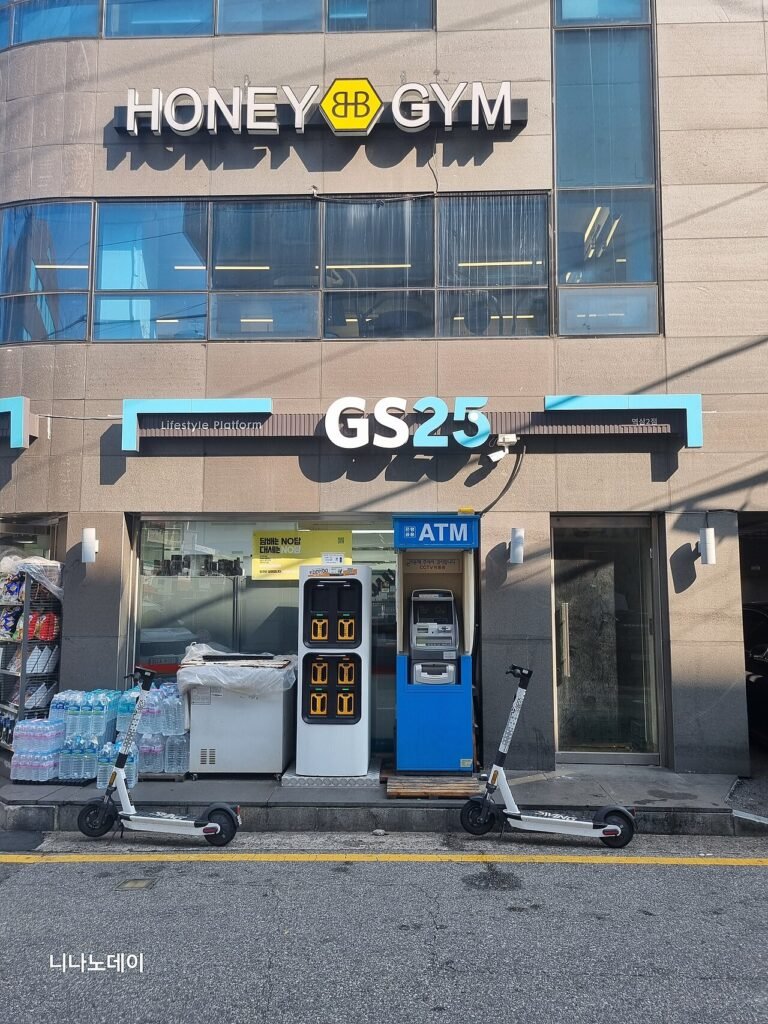
    Convenience stores like GS25 sell T-money cards, and many have an ATM. Photo: Ninanoday, CC0, via Wikimedia Commons
    • Cards: Visa and Mastercard work almost everywhere in cities. Tell your bank you’re traveling and check foreign transaction fees.
    • Cash: Keep some won for traditional markets, street food and small shops. Topping up a T-money card at a convenience store or subway machine usually needs cash.
    • T-money card: a rechargeable transport card for subways, buses and many taxis. Buy one at any convenience store (GS25, CU, 7-Eleven) or the airport.
    • Tax refunds: At stores marked “Tax Free,” foreign visitors staying less than six months can get an instant refund at the counter on purchases of ₩15,000 or more, up to ₩1,000,000 per purchase and ₩5,000,000 in total for the trip. Bring your passport when shopping.
    • Tipping: not expected in Korea. Prices are what you pay.

    5. Things Koreans Know That Guidebooks Don’t Tell You

    • Break time: Many restaurants close between lunch and dinner, often around 3 p.m. to 5 p.m. If you’re planning a late lunch, check the hours on Naver Map first.
    • Solo diners at BBQ places: Some Korean BBQ and hot pot restaurants require at least two orders, so a solo traveler may be turned away. Look for places that offer single portions, or go at lunchtime.
    • Lines move fast, waitlists move faster: At popular spots you may see a tablet at the door instead of a line. Enter your phone number and wait nearby.
    • Water is free: In most restaurants, water costs nothing, so don’t be surprised when it arrives without you asking. Tap water in Korea is generally fine to drink, and since COVID many restaurants serve bottled water for hygiene reasons.

    6. Health and Medication

    Korea has strict drug laws. Ordinary prescription medicine for personal use is usually fine if you keep it in its original packaging with a copy of your prescription. Medication containing controlled substances, including some ADHD medications, requires approval from Korea’s Ministry of Food and Drug Safety before you travel. If you take anything in this category, contact the Korean embassy in your country well ahead of your trip.

    Travel insurance is also worth it. Healthcare in Korea is high quality, but costs for visitors without insurance add up quickly.

    7. Packing Essentials

    • Plug adapter: Korea uses 220V with round two-pin plugs (Type C and F). Check that your chargers support 220V.
    • Comfortable walking shoes: Seoul is hilly and you’ll walk a lot, especially on subway transfers.
    • Weather-ready layers: Summers are hot and humid with a rainy season, and winters are cold and dry. Pack for the month you’re visiting.
    • Portable battery: you’ll be on your phone all day for maps and translation.

    8. Save These Emergency Numbers

    Number What it’s for
    112 Police
    119 Fire and ambulance

    Korea Travel Checklist FAQ

    Do Americans need a K-ETA for Korea in 2026?

    No. US citizens are on the temporary exemption list until December 31, 2026. You’ll still need to submit the e-Arrival Card unless you choose to get a K-ETA anyway.

    Is the e-Arrival Card mandatory?

    For most foreign visitors, yes. It’s free and takes a few minutes at e-arrivalcard.go.kr. Approved K-ETA holders and registered residents are exempt.

    Does Google Maps work in Korea?

    It shows places and public transit, but walking and driving directions have been limited for years. Korea approved Google’s use of detailed map data in February 2026, but Naver Map is still the safer choice for now.

    Do I need cash in Korea?

    A little. Cards work almost everywhere, but traditional markets, some street food stalls and T-money top-ups often need cash.

    Can I use my phone in Korea?

    Yes, as long as it’s unlocked for an eSIM or local SIM, or you use a pocket Wi-Fi. Check your phone supports eSIM before you buy one.

    What is the best time to visit Korea?

    Spring (April to May) and autumn (September to November) have the most comfortable weather. They’re also the busiest, so book early.